
Key Points:
-
360-Degree Imagery Requires A/B Testing: While 360-degree imagery increases engagement, simply implementing it is not enough. Retailers must actively A/B test key variables to ensure the viewer is optimized for maximum conversion and ROI, rather than letting a poor experience hurt performance.
-
Focus on Specific, Measurable Variables: Effective A/B tests on 360 imagery should measure primary metrics like Conversion Rate and Interaction Rate, while systematically testing variables such as visual Cue vs. No Cue, Auto-Spin Speed, and using the 360 Viewer as the Hero Asset.
-
Technical Consistency is Crucial for Valid Results: The reliability of A/B test results depends entirely on technical consistency. Both test variants must have identical, optimized loading speeds and photorealistic quality to ensure the test measures user behavior and not technical latency. Using a dedicated 3D product visualization software guarantees this essential technical foundation.
Why You Must A/B Test Your 360 Views
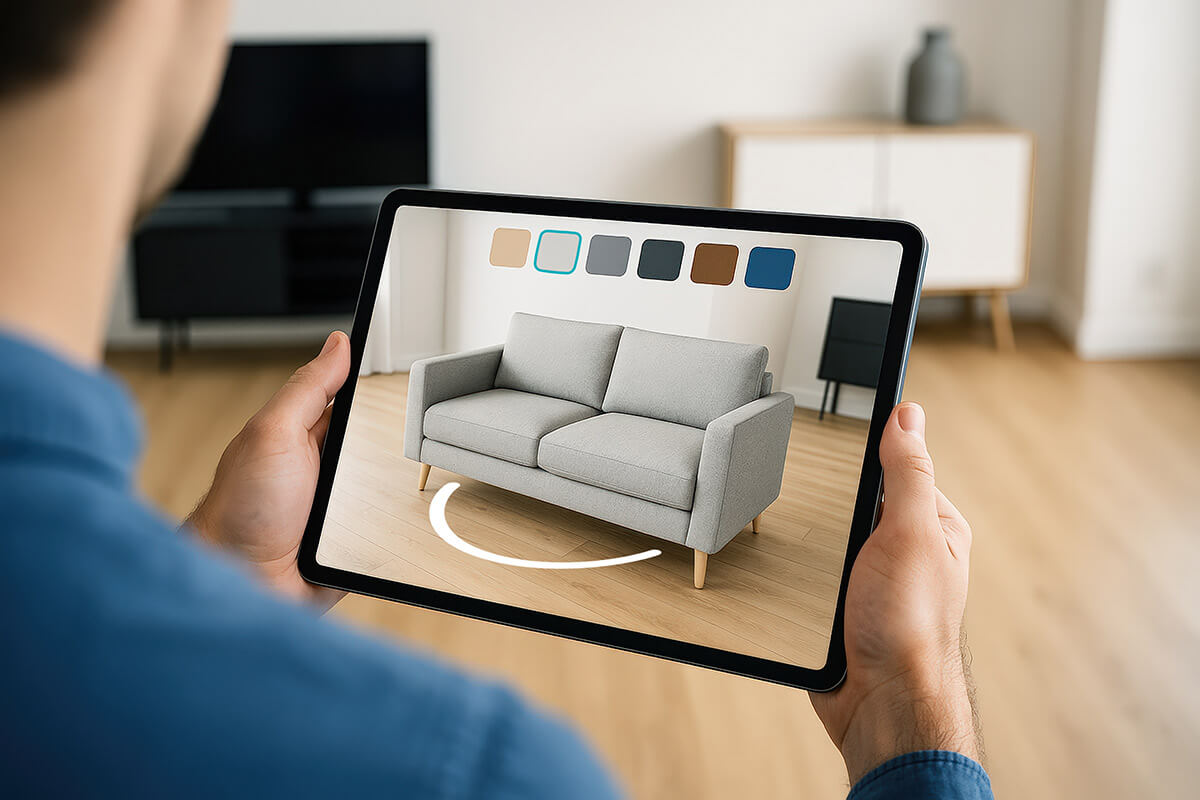
There is a clear industry consensus that 360-degree product imagery increases engagement. When customers can rotate a product, zoom into material details, or explore angles that static photography cannot capture, they stay longer and interact more.
The problem is that many retailers treat 360 views as a one-time upgrade. They launch a viewer, assume the job is done, and never revisit whether the experience is optimized for performance or user behavior.
Not all 360 viewers are created equal. A slow-loading viewer, a poorly placed spin set, or unclear interaction cues can hurt conversion more than a static image. If customers skip the 360 experience because it loads too slowly or feels hidden within the gallery, the investment loses value. Worse, the retailer might misinterpret poor results as proof that 360 imagery does not work.
A/B testing is the only way to unlock the full ROI of interactive visualization. With structured experimentation, retailers can validate what actually improves conversion, determine the ideal placement and behavior of their 360 viewer, and build a product page experience that maximizes engagement.
This guide provides a practical framework for designing, executing, and analyzing high-impact A/B tests for 360-degree imagery and explains why optimization is essential for long-term e-commerce growth.
Setting Up the Test: Variables and Metrics
To run a meaningful A/B test, retailers need to define clear success metrics and choose the right variables to compare. Without alignment on both, tests often produce ambiguous or misleading results.
Primary Metrics
These KPIs represent the behavioral outcomes that matter most for evaluating 360 performance.
- Conversion Rate - This is the most important indicator. If a 360 variant lifts conversion, the test is successful. Conversion reflects product confidence, clarity, and purchase readiness.
- Interaction Rate - This measures how many visitors actively engage with the 360 viewer. If interaction is low, the viewer may be hidden, slow, or confusing to use.
- Scroll Depth and Time on Page - Higher scroll depth and longer time on page typically indicate greater interest. If a 360 variant increases exploration without reducing conversion, it is likely improving the customer journey.
Together, these metrics reveal both the quality of engagement and the outcome of that engagement.
Key Test Variables
These variables determine how users encounter and interact with the 360 viewer. They form the basis of the test scenarios in the next section.
- Placement - Should the 360-viewer be the primary hero asset or a secondary element? Testing its position in the gallery is often one of the strongest drivers of conversion shifts.
- Auto-Play or Static Start - Some customers prefer a dynamic cue. Others find auto-spin distracting. Testing subtle motion, a short loop, or no auto-play at all is essential.
- CTA and Interaction Cue - A “Drag to Spin” overlay, a pulsing icon, or a static 360 badge each sends different engagement signals. The audience will respond differently based on clarity and design.
- Viewer Controls - Button placement, control size, and icon visibility all affect usability and interaction rate.
Establishing these variables before testing ensures that each experiment is controlled, intentional, and measurable.
🚫Stop Guessing. ✅Start Measuring
You have the A/B testing framework. Now, ensure your 360-degree imagery has the consistent technical foundation required for valid results. Don't let slow load times and inconsistent quality compromise your data. Book a 3D Visualization Demo Today!
Practical A/B Test Scenarios
Below are three high-impact A/B test scenarios grounded in common user-experience challenges. Each includes a hypothesis and the recommended implementation approach.
Test 1: Visual Cue vs. No Cue
Hypothesis
A clear, prominent “Drag to Spin” overlay increases interaction more than a subtle icon in the gallery.
Implementation
- Variant A should include only a small 360 icon within the image carousel.
- Variant B should incorporate a large, animated overlay on the hero image that appears on first load.
If interaction rate increases significantly in Variant B while maintaining conversion rate or improving it, the enhanced cue is more effective.
This is one of the most common and impactful tests because customers often need guidance to understand the 360 functionality.
Test 2: Auto-Spin Speed
Hypothesis
A slow, subtle auto-spin captures attention better than a static image without overwhelming users. This should lead to longer engagement time and deeper exploration.
Implementation
- Variant A should show the product as a static hero image.
- Variant B should trigger a slow 3-second continuous loop, with the spin pausing as soon as the user interacts.
The test should measure engagement time, interaction rate, and user drop-off. If the auto-spin is too fast, users may find it distracting. If it is too slow, they may not notice it. Testing is the only way to validate the right speed for your audience.
Test 3: 360 vs. Static-Only Gallery
Hypothesis
Replacing the static gallery with a primary 360 viewer and a few supporting still images will significantly increase conversion and overall visitor confidence.
Implementation
- Variant A should use a typical static gallery with a 360 tab or column as an optional view.
- Variant B should use the 360 viewer as the main asset and move static images below or beside it.
This test measures how strongly 360 imagery influences first impressions. It is especially effective for categories where material detail, size perception, or craftsmanship matter to the buying decision.
These tests give retailers actionable insight into how customers respond to 360 imagery. Over time, they create a benchmark for continuous optimization.
Technical Consistency: Why the Right Platform Matters
A/B testing only works when both variants are technically identical. If one test loads faster than the other or if image quality differs, the results become invalid. Instead of measuring user behavior, the test begins measuring latency or inconsistency.
The Flaw in Manual Testing
If Variant A loads two seconds faster than Variant B, the test is compromised. Load speed has a direct impact on conversion and engagement. Even minor inconsistencies in file size, rendering method, or delivery network distort the outcome.
Technical Requirements for Reliable A/B Testing
Accurate experiments depend on a visualization provider that guarantees the following:
- Consistent Loading Speed - Files must be optimized and equal in size so that both variants load at the same speed. Otherwise, performance differences overshadow user behavior insights.
- Photorealistic Quality - The 360 imagery must be high fidelity. Blurry, inconsistent, or mismatched renders create noise in the test results, distracting from the actual variable being tested.
- Easy Integration - The viewer should integrate seamlessly with A/B testing platforms like Optimizely, VWO, or Google Optimize. Fragmented scripts or manual configurations create errors and slow down the page.
Cylindo’s Role
Cylindo’s 3d product visualization software and the visual commerce platform solve these challenges by ensuring consistent, high-fidelity asset delivery across all variants.
The Cylindo platform is optimized for stable load times, scalable rendering, and compatibility with major testing tools. This ensures your A/B tests measure actual customer behavior instead of technical inconsistencies.
With Cylindo, retailers can experiment with confidence because every variant is grounded in the same technical foundation. This eliminates the risk of false positives, inconclusive tests, or wasted optimization cycles.
Ready to Test and Optimize Your Product Pages
Don't guess what your customers want - measure it. Cylindo provides the consistent, high-fidelity 360-degree imagery and visualization tools required to run accurate A/B tests and maximize your product page conversion rates today. Request a Demo and Start Optimizing.