
TL;DR: AI shopping agents don't browse. They query, evaluate structured data, and execute. Furniture brands optimised only for human eyeballs will be invisible to the autonomous buyers now entering the funnel. The brands that win will be the ones whose product data is structured, accurate, and machine-readable.
Key points:
-
Agentic commerce is already here: AI assistants like Google's Universal Cart are intercepting purchase journeys before a human ever lands on a product detail page. The furniture brands these agents recommend will be decided by the quality of structured data — not the quality of creative.
-
AI agents cannot recommend what they cannot read: Flat product feeds, incomplete metadata, and data that lives only inside marketing copy or PDF spec sheets are functionally invisible to autonomous shopping systems. Consistent, structured product data across every channel is the minimum requirement for AI visibility.
-
Structured 3D product data is the differentiator: High-fidelity 3D models encoding accurate geometry, dimensions, and configuration relationships are the machine-readable product truth layer that AI systems use to validate and recommend. The brands building this infrastructure now are building a compounding advantage.
The agentic commerce shift
Your next customer may never visit your website. Instead, an AI agent will visit it on their behalf, evaluate your catalog against their criteria, and decide whether to recommend you in under a second, based on data your team may not have realised was even being read.
The pattern is no longer hypothetical. AI assistants like Google's Universal Cart are already intercepting purchase journeys before a human ever lands on a product detail page, and the pace at which agentic commerce is being embedded into mainstream consumer tools is accelerating quarter over quarter.
The dynamic is particularly consequential in furniture. The US Furniture Retailers Report 2026 identifies fit uncertainty as one of the most persistent barriers to e-commerce conversion. An AI agent attempting to resolve fit uncertainty on the buyer's behalf needs structured data to work from — it cannot squint at a hero photograph and intuit whether a sectional will clear the radiator on the south wall of a 4m by 3m living room.
The AU Furniture Retailers Report 2026 frames the same point from the consumer side, noting that confidence in modern furniture shopping is built less through persuasion and more through usability. For an autonomous agent operating on a customer's behalf, the data structure of your product catalog effectively is the usability, and understanding how that data performs across channels is the first step to closing the gap.
The strategic shift this forces on furniture brands is uncomfortable but unavoidable. The discipline of optimising for human browsing, which has driven a generation of merchandising and creative investment, now sits alongside the equally critical discipline of optimising for machine interpretation. The brands that grasp this early will be the ones AI agents recommend. Everyone else will compete for whatever human traffic the agents have not already pre-decided.
How agentic commerce works in the furniture funnel
To understand what AI agents actually need from your catalog, imagine a customer typing a prompt into a shopping assistant: "Find me a modular sofa in dark grey under £2,000 that fits in a 4m by 3m room and ships within four weeks." The agent immediately translates that natural language into structured queries across your product feed, marketplace listings, and any third-party data sources where your catalog is represented. It looks for:
-
Dimensions: Expressed in machine-readable fields — not buried in PDF spec sheets.
-
Material specifications: Attached as metadata — not implied in marketing copy.
-
Configuration options: Encoded as structured graphs — not locked inside a visual configurator the agent cannot operate.
-
Pricing and availability: Updated in something close to real time — not cached from last quarter's feed.
Evaluation happens entirely in that structured layer. The agent is fundamentally incapable of evaluating a lifestyle photograph the way a human shopper does. A beautifully styled hero shot communicates almost nothing useful to an autonomous system. The metadata behind that shot, by contrast, is exactly what allows the agent to compare your sofa against a competitor's and decide which one matches the customer's brief more precisely.
Execution then follows, sometimes invisibly. A growing number of agents are already capable of adding products to cart and initiating checkout flows without the human ever opening a browser tab on your domain. The funnel is being intercepted before the human arrives, and the brands optimised for that interception are quietly capturing share that traditional analytics dashboards are not yet measuring well. The question is whether your product data is structured enough to be part of what those agents recommend, or whether you are invisible to them entirely.
What makes a furniture product AI-recommendable
Three properties separate furniture products that AI agents can confidently recommend from products that get silently filtered out.
The first is genuinely structured product data — accurate dimensions, material origin, durability tiers, configuration options, and category taxonomy expressed as machine-readable metadata rather than narrative copy or downloadable attachments. The second is data consistency across every channel the brand publishes through, because an agent encountering different dimensions on your website versus a marketplace listing will downweight the brand on reliability grounds and recommend a competitor whose data matches itself.
The third is platform infrastructure capable of producing and maintaining that data at the scale a real furniture catalog requires — distributing a single verified asset library to every endpoint without version drift or metadata mismatch.
The deeper architectural principle underneath all of this is worth stating directly. The constant in your technology stack should never be the AI model — models will change every twelve months for the foreseeable future and you cannot rebuild your data infrastructure that often.
The constant must be the structured product data that feeds the models. That data layer is what stays valuable across every successive generation of agents. Brands that bet on a particular model rather than on their own data foundation will find themselves rebuilding repeatedly. Brands that invest in the data layer compound their advantage with every new agent that arrives.
Proof of Impact: Cozey
360 HD Viewer. AR. Cylindo Create. Every Channel. Consistent Structured Data.
Cozey uses Cylindo's 360 HD Viewer across every product page to visualize all available configurations, AR to let customers place furniture in their own spaces before buying, and Cylindo Create to generate on-demand marketing imagery and animated GIFs — all from a single 3D asset library. The same asset that powers the PDP powers every marketing channel. There is no version drift, no visual inconsistency, no channel where the brand experience breaks down.
Read the full case study here.
"We opted for Cylindo over other vendors due to its remarkable fast loading speed, exceptional quality of renders, and agility in keeping up with our fast-paced projects."
— Félix Robitaille, Director of Marketing, Cozey
What furniture brands must do now
The practical first move is to audit your structured data against the fields AI agents actually query. Map your current product feed against dimensions, materials, configuration options, category taxonomy, pricing, and availability.
Treat any field that lives only inside human-readable marketing copy or a PDF specification document as effectively invisible to autonomous systems. The gap between what your team thinks is published and what is actually machine-readable is almost always larger than expected — and the gap is where competitors are already winning.
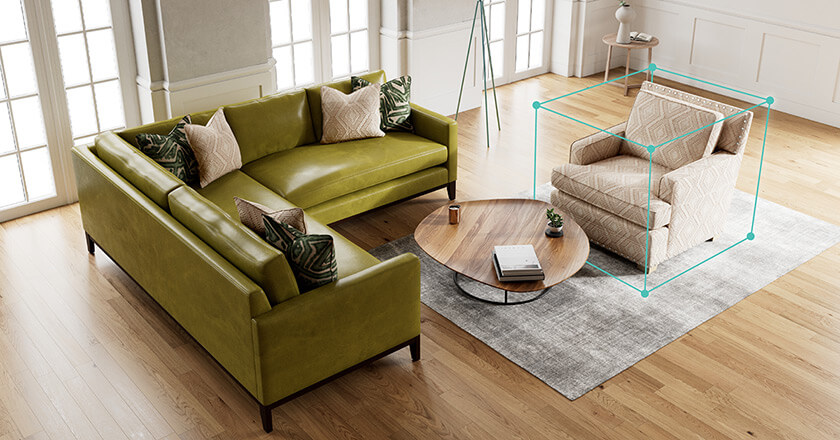
The second move is to invest in 3D asset infrastructure as the machine-readable product truth layer underneath everything else. High-fidelity 3D models encode the geometry, dimensions, and configuration relationships that AI systems use to validate and recommend products in ways flat catalogs cannot match.
Proof of Impact: MAKE Nordic
10% → 50% Configuration Adoption. 5x Increase. Year-on-Year Revenue Growth.
By structuring product complexity into a navigable interface backed by a robust 3D foundation, MAKE Nordic grew configurator adoption from roughly 10% to 50% of relevant sessions — a fivefold increase. What changed was not the product range. What changed was the data infrastructure that made product complexity legible rather than overwhelming. The same structured data that serves human shoppers is the same data AI agents query when evaluating whether the brand's modular range meets a buyer's specification.
Read the full case study here.
Even brands who believe they are already ahead on digital infrastructure tend to see meaningful lift when they move to a properly structured foundation. The Six Trends Report 2026 puts the average conversion increase at 13.6% even for brands who already have visualization beyond static images — which means the bar for AI-readiness is meaningfully higher than most internal teams assume.
The invisible brand problem
The window to differentiate on AI readiness is open right now, and it is not going to stay open indefinitely. Furniture brands that build structured product infrastructure across 2025 and 2026 will become the catalog agents reach for by default.
Brands that wait will end up competing for whatever residual human traffic the agents did not intercept on the way through. The competitive geometry of the category is being rewritten in real time, and most of the rewriting is happening below the surface of any dashboard the brand currently looks at.
The principle worth carrying out of this article is a simple extension of the broader structured data argument. AI alone generates images, but structured data is what generates images consumers actually trust. Apply the same logic to recommendations: AI alone generates recommendations, but structured data is what generates recommendations consumers actually receive.
The single 3D asset that powers your 360 viewer, your AR experience, your configurator, and your lifestyle imagery is the same asset — when built on Cylindo's platform — that feeds every downstream channel, including the AI product feeds that agentic shoppers now query first.
Build it once. Let it work everywhere, including in every context you haven't yet anticipated.

Frequently Asked Questions
What is an AI shopping agent?
An autonomous AI system that researches, evaluates, and executes product purchases on behalf of a user based on a natural language prompt. Examples include Google's Universal Cart and AI-powered browser assistants that can add to cart and initiate checkout without the user ever interacting with the product detail page directly. The agent operates on structured data — dimensions, materials, configuration options, pricing, availability — not visual or editorial content.
How do AI agents find furniture products?
By querying structured product data from brand websites, marketplace listings, and product feeds — evaluating dimensions, materials, configuration options, pricing, and availability rather than lifestyle imagery. The US Furniture Retailers Report 2026 identifies fit uncertainty as one of the most persistent barriers to e-commerce conversion, and structured data is how AI resolves that on the buyer's behalf. Brands whose data is incomplete or inconsistent are filtered out before a human ever sees the results.
What product data do I need to be AI-recommendable?
Accurate dimensions, material specifications, configuration options expressed as structured metadata, consistent pricing and availability data across all channels, and high-fidelity 3D models that validate the visual product claims the metadata is making. Anything buried only inside marketing copy or PDF attachments effectively does not exist from the agent's perspective. Cylindo's Export product is used to organize, bundle, and export visuals in the correct format and file type for different channels' requirements.
Is my furniture brand already visible to AI shopping agents?
If your product data is incomplete, inconsistent across channels, or buried in PDF spec sheets rather than structured metadata fields, AI agents will either skip your products or recommend competitors whose data is cleaner. Even brands with strong digital infrastructure see an average 13.6% conversion lift after moving to a properly structured foundation — the bar for AI-readiness is higher than most internal teams assume. The data audit described above is the fastest way to identify the gap.