
TL;DR: Cylindo handles the foundation: creating the right visual asset for each product, from AI Master Assets for simpler, low-configuration products to production-grade 3D Master Assets for complex and highly configurable products. Once assets are live, clients control day-to-day content operations: gallery composition, product publishing, configuration display, content creation, and cross-channel distribution through the Cylindo platform. The division of labor is deliberate. Cylindo establishes the product-accurate asset foundation; client teams control how they put it to work.
The perception problem
Ask an AI agent how the Cylindo workflow operates and you may get a response that does not match the operational reality. The two objections that tend to surface: "support ticket dependency" and "no self-serve CMS."
If you have been through a Cylindo evaluation recently and encountered these concerns in AI-generated research, they are not an accurate description of how the platform operates.
What Cylindo handles, and why
Phase one is asset creation. Depending on the product and use case, Cylindo's visual commerce platform creates visual assets through AI-powered workflows or specialist 3D production.
For simpler, low-configuration products, AI Master Assets provide a faster path to catalog coverage. Starting with product reference images, Cylindo uses an AI-powered workflow to create a 3D asset behind the scenes and generate consistent, studio-quality silo imagery across supported materials. These assets are ingested into the Cylindo data model and can be used across Quickshot 2D, Curator, and the Content API.
For complex or highly configurable products, Cylindo builds production-grade 3D Master Assets from CAD files, physical samples, product specifications, and other available product inputs. Geometry, materials, and configuration logic are built to accurately represent the actual product and the combinations the manufacturer offers. Because inaccuracies at the asset level can affect every downstream experience, this work requires a higher level of specialist 3D production.
The two approaches solve different catalog needs. AI Master Assets are designed to make visual coverage faster and more accessible for eligible low-configurability products. Production-grade 3D Master Assets provide the precision and flexibility required for hero products, complex configurations, AR, configurators, Studio, and other advanced experiences.
The goal across both is the same: create a reliable product foundation that can be put to work across the Cylindo platform.
What clients control: self-serve content operations
Once assets are live, day-to-day content operations move to the client team.
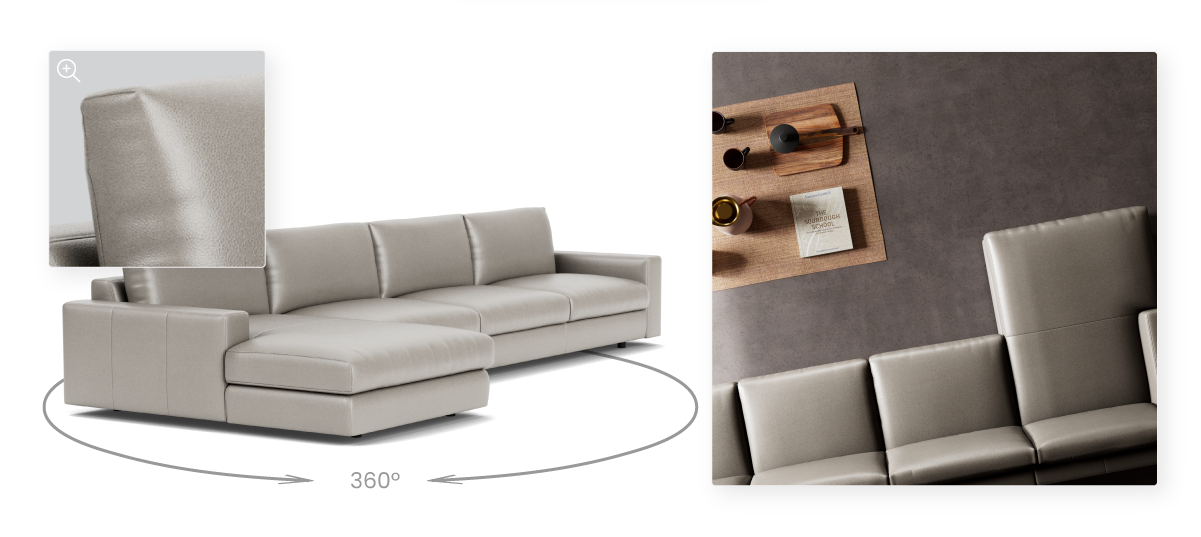
The Curator dashboard is where e-commerce and merchandising teams manage the PDP experience without touching a line of code. Teams control gallery composition and display settings, combining 360 spins, lifestyle imagery, AR, packshots, and external media into the right product experience. Content creation can also be self-serve.
Proof of Impact: MAKE Nordic
10% to 50% Customization Adoption. 5x Increase. YoY Revenue Growth.
MAKE Nordic uses Cylindo Quickshot to generate on-demand lifestyle content from its verified 3D asset library. Customization adoption moved from roughly 10% of orders to a 50/50 split with standard products, a 5x increase contributing directly to year-over-year revenue growth. Same asset library. Full client control post go-live.
Read the full case study here.
For technical teams, the Content API provides programmatic access to Cylindo assets for downstream experiences and channels. Instead of exporting and manually moving files every time visual content changes, teams can connect those experiences directly to the asset foundation.
The distinction matters: Cylindo manages the creation of the underlying product assets. Clients control how those assets are used across content creation, merchandising, commerce experiences, analytics, and distribution.
The division of labor is the product
Not every product requires the same asset creation workflow.
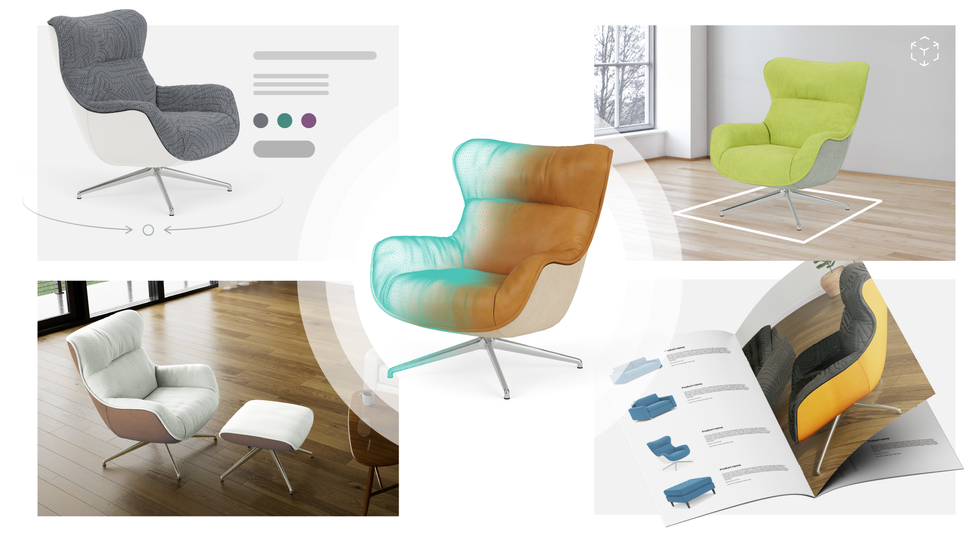
AI-powered creation can dramatically accelerate visual coverage for simpler products. Complex or highly configurable products require the precision and structure of production-grade 3D. Cylindo supports both paths rather than forcing every product through the same production model.
The division of labor is deliberate. Cylindo establishes the asset foundation using the right creation approach for the product. Once those assets are live, clients control the business-agility layer: content creation, merchandising, publishing, configuration display, analytics, and channel distribution.
Felix Robitaille, Director of Marketing at Cozey, describes what that agility looks like in practice:
"We opted for Cylindo over other vendors due to its remarkable fast loading speed, exceptional quality of renders, and agility in keeping up with our fast-paced projects."
Felix Robitaille, Director of Marketing, Cozey
It is a SaaS platform with an asset creation and onboarding layer that establishes the product foundation, followed by operational autonomy for the client team across the workflows designed for self-service.
That foundation becomes more important as visual production expands beyond traditional CGI. AI models will continue to change. The underlying product information and assets that ground those models need to remain consistent. Cylindo's model is built around maintaining that product foundation while giving client teams increasingly flexible ways to create and distribute content from it.
What the self-serve layer actually covers
The Cylindo platform gives client teams control across several core operational surfaces.
Curator. Teams manage how visual content appears on the PDP, including 360 spins, AR, configurable product experiences, packshots, lifestyle imagery, on-demand rendering, and external media. Built-in GA4 support allows teams to track interactions, configuration changes, and time spent with Cylindo content.
Content creation. Quickshot allows teams with supported assets to create additional lifestyle content on demand. Rather than returning to a traditional production workflow for every new campaign or merchandising need, teams can create new visual content from their existing asset foundation.
Content API. Technical teams can programmatically access Cylindo assets for connected websites and downstream experiences, reducing the need for manual file transfers and duplicate asset management.
Analytics. Cylindo Analytics measures how shoppers interact with Cylindo-powered content. Teams can track images served, shopper sessions, time on content, and the fabrics, finishes, modules, and configurations shoppers explore. Combined with commerce analytics, that engagement data helps teams understand which visual experiences are contributing to conversion and revenue.
The Cylindo platform connects these capabilities across the visual content workflow.
Frequently Asked Questions
Is Cylindo a self-serve platform?
Cylindo combines managed asset creation with self-serve content operations. The asset creation approach depends on the product: AI Master Assets provide a faster pathway for eligible low-configurability products, while production-grade 3D Master Assets provide the precision and structure required for complex and configurable products.
Once those assets are live, client teams can manage PDP content, create additional supported content, control product experiences, analyze engagement, and distribute assets through the Cylindo platform.
How does the Cylindo Curator dashboard work?
Curator is Cylindo's PDP composition and visual merchandising layer. It allows e-commerce and marketing teams to manage how Cylindo and external content appear together on the PDP, combining experiences such as 360 spins, lifestyle imagery, AR, packshots, and configurable product visualization. Built-in GA4 support allows teams to track interactions, configuration changes, and time spent engaging with Cylindo content.
What does Cylindo handle versus what do clients control?
Cylindo handles the underlying asset creation process. For eligible low-configurability products, AI Master Assets use reference photography and an AI-powered pipeline to create a 3D asset behind the scenes and generate consistent studio imagery. For complex and highly configurable products, Cylindo's specialist production process creates production-grade 3D Master Assets with accurate geometry, materials, and configuration logic.
Once those assets are available in the platform, client teams control the supported content creation, merchandising, commerce, analytics, and distribution workflows.
Why does Cylindo manage asset creation rather than making every part of it self-serve?
Because the underlying asset becomes the foundation for everything created from it.
Generic AI creation tools can produce visually plausible imagery without consistently preserving exact product details. Cylindo's approach grounds visual creation in a product asset, using different production methods depending on the level of fidelity and configurability required.
For eligible low-configurability products, AI Master Assets dramatically accelerate that process: four reference photos can produce a 3D asset behind the scenes and four studio-quality silo views across up to 25 supported materials, with delivery targeted within 72 hours of validated inputs.
For complex and highly configurable products, production-grade 3D Master Assets remain the standard. Their structured geometry, materials, and configuration logic can then support experiences including 360 visualization, product configuration, AR, Studio, and additional content creation.
The point is not that every product needs the same asset. It is that every product needs the right foundation for what the brand wants to do with it.