---
title: "The Death of the Static PDP: Why Shoppers Expect Endless Aisles"
description: The static product page forces furniture brands to choose between visual completeness and production cost. Here's how the endless aisle, built on one 3D Master Asset rendering unlimited variants, makes that choice obsolete.
image: https://blog.cylindo.com/hubfs/12%20Ways%20to%20Improve%20the%20Ecommerce%20Customer%20Experience/Furniture%20product%20page%20experience%20with%20360%20views%20and%20zoom.png
---
[  Cylindo Logo](https://www.cylindo.com/)
- Platform
Overview
- [How it works](https://www.cylindo.com/how-it-works/)
Core Platform
- [Asset Hosting A visual source of truth for every product.](https://www.cylindo.com/platform/core/#asset-hosting)
- [Content Creation Produce channel-ready content at catalog scale.](https://www.cylindo.com/platform/core/#content-creation)
- [Commerce Tools Turn product pages into digital showrooms.](https://www.cylindo.com/platform/core/#commerce-tools)
- [Distribution Compose, push, and measure across channels.](https://www.cylindo.com/platform/core/#distribution)
Bundles
- [Lifestyle Add-on 3D and AI lifestyle imagery tools - (Best for visuals at scale)](https://www.cylindo.com/platform/lifestyle/)
- [3D Design Customize multi-component or multi-product bundles in real time. - (Best for e-commerce)](https://www.cylindo.com/platform/3d-design/)
- [Compare bundles Check which bundle fit your needs](https://www.cylindo.com/platform/compare-bundles/)
[](https://cta-service-cms2.hubspot.com/web-interactives/public/v1/track/click?encryptedPayload=AVxigLI6OOO%2FX2J5LDxKXkS4hv6vtKaU6HSjeVDZjXWZcmceLj8daUydus447qAu%2BlJ559eJAETFdNThy3brmpc78RjSqK91TBGV3DRXWAT9CYaUwQTfpUcS4gyKy0BGxMrUXfiXXfPcuqDC4YFL2Q4t8zSqa5LBCOoe2%2B239nHYL4sjznAmPVn12nKAd0a4eGw%3D&portalId=4585441)
- Use cases
By outcome
- [Convert more shoppers](https://www.cylindo.com/use-cases/outcome/#convert-more)
- [Scale content creation](https://www.cylindo.com/use-cases/outcome/#scale-content)
- [Win across every channel](https://www.cylindo.com/use-cases/outcome/#win-across-every-channel)
By vertical
- [Furniture & home furnishings](https://www.cylindo.com/use-cases/verticals/#home-furniture)
- [Kitchen & bath](https://www.cylindo.com/use-cases/verticals/#kitchen-bath)
- [Lighting](https://www.cylindo.com/use-cases/verticals/#lighting)
- [Cabinetry](https://www.cylindo.com/use-cases/verticals/#cabinetry)
- [Outdoor living](https://www.cylindo.com/use-cases/verticals/#outdoor-living)
- [Contract & commercial](https://www.cylindo.com/use-cases/verticals/#contract-commercial)
By team
- [Creative](https://www.cylindo.com/use-cases/team/#creative)
- [Marketing](https://www.cylindo.com/use-cases/team/#marketing)
- [Digital & E-commerce](https://www.cylindo.com/use-cases/team/#digital-e-commerce)
###### [ Boosts online revenue +75% and AOV +44% with Cylindo Read more \>](https://cta-service-cms2.hubspot.com/web-interactives/public/v1/track/click?encryptedPayload=AVxigLKugaXLIJ%2FBi8rQ6ZH3KScymjpgFZMcslnX61buCaP7eztqyM%2FImxHLX0dtAnupUJVVBxkGawM3jYjCADACR7YiwNpGfaglek7MHXGRWftKwG7GteizyxZu8v4WpsEWrFZus%2Fqgv%2Fptk4DWBS%2FxWd2Sz72hNE9rvQIpn%2FyvuOFQoOyDEsBtEbUQ7wUe8xfZasMvt6gQZf%2FMx0eDGfZRZoo6%2BBs%3D&portalId=4585441)
- Customers
Customers
- [Customer Stories](https://www.cylindo.com/customer-case-studies/)
- [Customer Showcase](https://www.cylindo.com/customers/customer-showcase/)
Who we serve
- [B2B](https://www.cylindo.com/customers/who-we-serve/#b2b)
- [B2C](https://www.cylindo.com/customers/who-we-serve/#b2c)
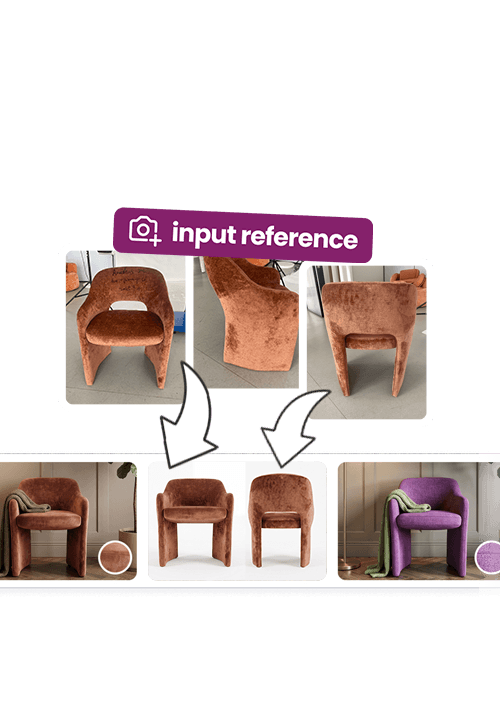
###### [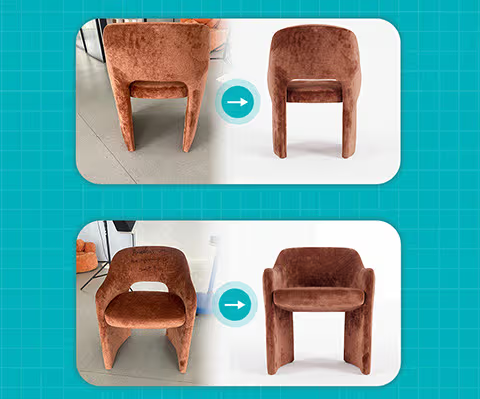 Introducing AI Master Assets Send four product photos and Cylindo produces four studio-quality silo shots in your chosen material, anchored to a 3D asset, with no content creation fee. Read more \>](https://cta-service-cms2.hubspot.com/web-interactives/public/v1/track/click?encryptedPayload=AVxigLKSbU1o5Ysj%2BcPHemzhD%2BQkYuIdvXHUOoj2SSm65frD8BvU5oP5VLFHOkvUADHGADgl04yRtO%2F3Jqiaet2IuCz1XbqguPoyO3c92XWtIN8Q898MYXZrbe2u9R7UN8Ce1CUFr5%2BOkaGZ22CGY8pDTNfyy3htJSI3nfzs96PEjUL2WpHb6vVuwzjqYeFJvRYAJpVWvH4l8jP9&portalId=4585441)
- Resources
Learn
- [Blog](https://blog.cylindo.com)
- [Cylindo library](https://www.cylindo.com/cylindo-content-library/)
Evaluate
- [ROI calculator](https://www.cylindo.com/roi-calculator/)
- [AI Master Assets test](https://www.cylindo.com/ai-master-assets-test/)
- [Business Impact](https://www.cylindo.com/business-impact/)
- [Free custom 3D and AI report new See what 3D + AI could be worth to your brand. Free custom report + ROI model in 48h.](https://www.cylindo.com/custom-report/)
- [Free AI readiness report new See how ChatGPT, Claude & Perplexity read your product pages, plus your top 10 fixes.](https://www.cylindo.com/ai-readiness-report/)
Support
- [Help center](https://learn.cylindo.com/help)
- [Ask support](https://learn.cylindo.com)
- [Change log](https://learn.cylindo.com/changelog)
###### [ Modern Search Discoverability Guide Learn how Google's 2026 AI search updates affect furniture discovery—and what to do to keep your products visible in AI-powered search. Download \>](https://cta-service-cms2.hubspot.com/web-interactives/public/v1/track/click?encryptedPayload=AVxigLJEl7T5dyLLkk%2FWEwwy6TlSBb9kSsYlkDUJ6tN9HhhUvn2hsLUaVYADFKjCAZUMYOr%2BPNOJgpkY2PJicVb3%2FGWl538Jmd3qJuCz8hf19svC47f2bjpQkoTlSgztHrzKcSDNaxvFrc0rZaFt1%2F75i9%2FVuns6K6Hkjfj7dt3UXOSlN1T4Ca%2Bt77aBq2Sgij0EtMCEjYZ%2Bc6O4olPgSsi2vkIcBzleG5bv9eDOO4D%2B%2BwNV2TMwtKv4x3g%3D&portalId=4585441)
- [Book demo](https://www.cylindo.com/book-meeting/)
- [Receive pricing](https://www.cylindo.com/receive-pricing/)
- [Login](https://app.cylindo.com/login)
- Platform
Overview
- [How it works](https://www.cylindo.com/how-it-works/)
Core Platform
- [Asset Hosting A visual source of truth for every product.](https://www.cylindo.com/platform/core/#asset-hosting)
- [Content Creation Produce channel-ready content at catalog scale.](https://www.cylindo.com/platform/core/#content-creation)
- [Commerce Tools Turn product pages into digital showrooms.](https://www.cylindo.com/platform/core/#commerce-tools)
- [Distribution Compose, push, and measure across channels.](https://www.cylindo.com/platform/core/#distribution)
Bundles
- [Lifestyle Add-on 3D and AI lifestyle imagery tools - (Best for visuals at scale)](https://www.cylindo.com/platform/lifestyle/)
- [3D Design Customize multi-component or multi-product bundles in real time. - (Best for e-commerce)](https://www.cylindo.com/platform/3d-design/)
- [Compare bundles Check which bundle fit your needs](https://www.cylindo.com/platform/compare-bundles/)
- Use cases
By outcome
- [Convert more shoppers](https://www.cylindo.com/use-cases/outcome/#convert-more)
- [Scale content creation](https://www.cylindo.com/use-cases/outcome/#scale-content)
- [Win across every channel](https://www.cylindo.com/use-cases/outcome/#win-across-every-channel)
By vertical
- [Furniture & home furnishings](https://www.cylindo.com/use-cases/verticals/#home-furniture)
- [Kitchen & bath](https://www.cylindo.com/use-cases/verticals/#kitchen-bath)
- [Lighting](https://www.cylindo.com/use-cases/verticals/#lighting)
- [Cabinetry](https://www.cylindo.com/use-cases/verticals/#cabinetry)
- [Outdoor living](https://www.cylindo.com/use-cases/verticals/#outdoor-living)
- [Contract & commercial](https://www.cylindo.com/use-cases/verticals/#contract-commercial)
By team
- [Creative](https://www.cylindo.com/use-cases/team/#creative)
- [Marketing](https://www.cylindo.com/use-cases/team/#marketing)
- [Digital & E-commerce](https://www.cylindo.com/use-cases/team/#digital-e-commerce)
- Customers
Customers
- [Customer Stories](https://www.cylindo.com/customer-case-studies/)
- [Customer Showcase](https://www.cylindo.com/customers/customer-showcase/)
Who we serve
- [B2B](https://www.cylindo.com/customers/who-we-serve/#b2b)
- [B2C](https://www.cylindo.com/customers/who-we-serve/#b2c)
- Resources
Learn
- [Blog](https://blog.cylindo.com)
- [Cylindo library](https://www.cylindo.com/cylindo-content-library/)
Evaluate
- [ROI calculator](https://www.cylindo.com/roi-calculator/)
- [AI Master Assets test](https://www.cylindo.com/ai-master-assets-test/)
- [Business Impact](https://www.cylindo.com/business-impact/)
- [Free custom 3D and AI report new See what 3D + AI could be worth to your brand. Free custom report + ROI model in 48h.](https://www.cylindo.com/custom-report/)
- [Free AI readiness report new See how ChatGPT, Claude & Perplexity read your product pages, plus your top 10 fixes.](https://www.cylindo.com/ai-readiness-report/)
Support
- [Help center](https://learn.cylindo.com/help)
- [Ask support](https://learn.cylindo.com)
- [Change log](https://learn.cylindo.com/changelog)
- [Book demo](https://www.cylindo.com/book-meeting/)
- [Receive pricing](https://www.cylindo.com/receive-pricing/)
- [Login](https://app.cylindo.com/login)
[Back to Blog](https://blog.cylindo.com/all)
# The Death of the Static PDP: Why Shoppers Expect Endless Aisles

[Jen Rasmussen](https://blog.cylindo.com/author/jen-rasmussen) Published: September 11, 2026
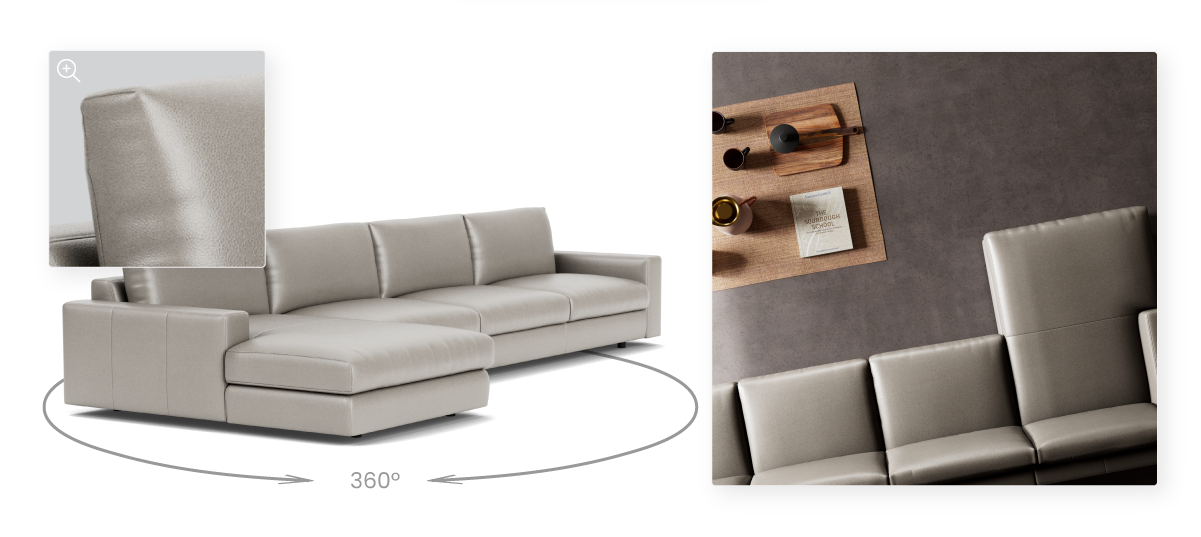
> TL;DR: A furniture brand with 50 fabric options either photographs one and loses the other 49 sales, or photographs all 50 and absorbs a cost that does not scale. The endless aisle replaces that impossible choice with one 3D Master Asset that renders every variant on demand. Life Outdoor Living's two-person team grew e-commerce share from 3.7% to 6.8% using it. MAKE Nordic's customization adoption went from 10% to 50%.
## The impossible choice
Your sofa comes in 50 fabrics. You photograph one.
Every shopper whose preferred fabric is not shown may leave, settle, or convert at a lower rate than they would with visual confirmation. That is the commercial cost of a static PDP, playing out quietly across every product in a catalog that cannot afford to photograph all of its variants.
The alternative is not obviously better. Photographing all 50 fabrics costs between €130,000 and €150,000 annually for a brand the size of Life Outdoor Living. That is the cost of the status quo for a mid-market furniture brand trying to compete on visual coverage. Larger catalogs pay more. And then a new colorway launches and the photoshoot cycle starts again.
The static PDP is not neutral. It is a decision to leave revenue on the table for every configuration the shopper cannot see. The [Cylindo US Retailers Report 2026](https://www.cylindo.com/cylindo-content-library/reports/top-10-usa-furniture-retailers-report-2026/) identifies fit uncertainty as one of the most persistent barriers to e-commerce conversion in furniture. Unshown variants are fit uncertainty at catalog scale.
## What the endless aisle actually is
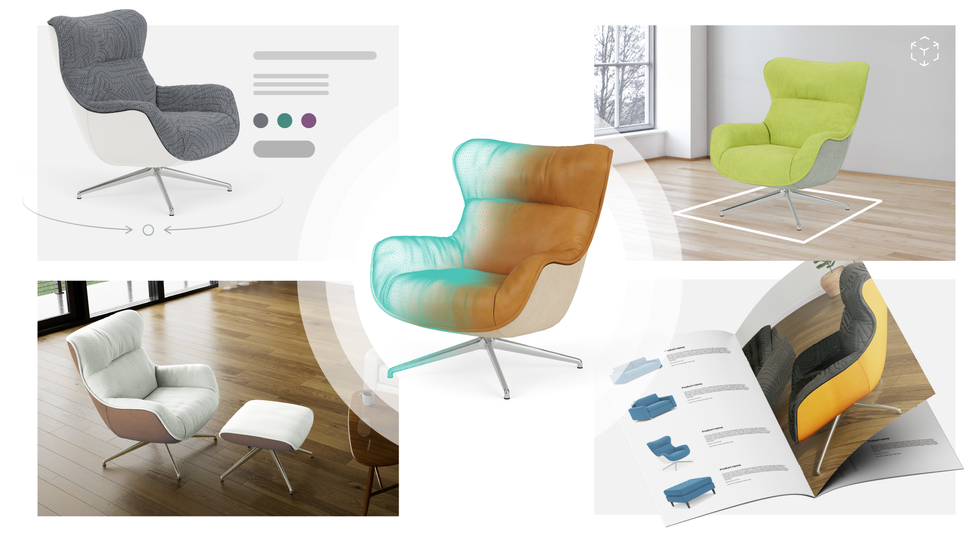
One verified 3D Master Asset per product. Every fabric, every finish, and every supported configuration visualized from the same structured 3D foundation. No photoshoot per variant. No manual rebuild when something changes. No gap between what the brand sells and what the shopper can actually see.
When a new fabric gets added to the range, it is applied to the existing Master Asset. That updated asset can then power consistent visuals across 360 spins, product configurations, and AR experiences. The shopper sees the correct product. The team does not schedule a photoshoot.
That is what makes comprehensive visual coverage achievable for a team of any size. The [Cylindo Modular Designer](https://www.cylindo.com/platform/products/modular-designer/) extends the same principle to configurable products, where the number of valid combinations can reach into the millions. Five million combinations from one structured asset library. No studio. No incremental production cost per combination.
## The efficiency proof
Life Outdoor Living's e-commerce team is two people.
Before Cylindo, e-commerce accounted for 3.7% of total revenue. After deploying Cylindo 3D visualization and AR, that figure moved to 6.8%. Online revenue grew 75%. AOV increased 44%. Photography costs dropped by €130,000 to €150,000 annually. Two people. No expanded headcount. No larger photography budget. The production model changed and the output scaled with the catalog rather than with the team.
Giel van Balen, E-commerce Manager at Life Outdoor Living, describes the shift from the inside:
> "Once we launched, the whole team was astonished by the quality of the visuals and how clearly they elevated the customer experience."
>
> Giel van Balen, E-commerce Manager, Life Outdoor Living
The [full Life Outdoor Living case study](https://www.cylindo.com/customer-case-studies/lifeoutdoorliving/) covers the operational detail behind the transition.
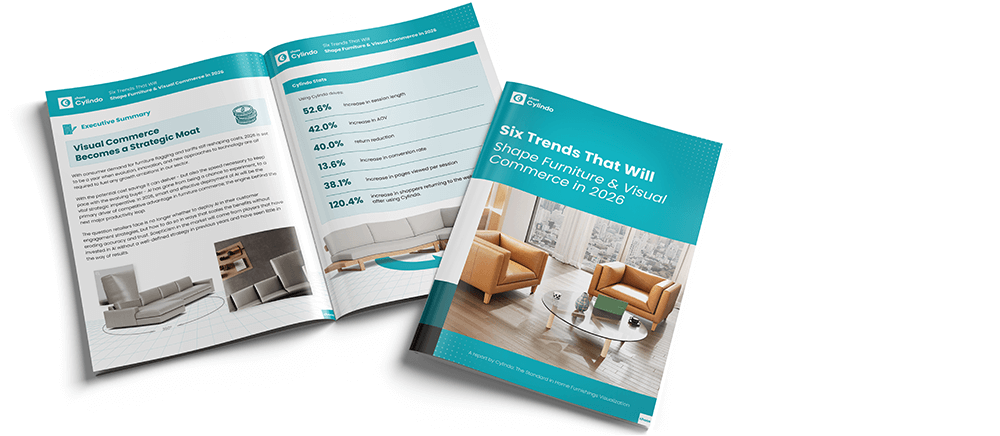
Free Report
### Six Trends That Will Shape Furniture and Visual Commerce in 2026
The full market context on catalog scale, visual coverage, and the operational shift from photography to 3D, including benchmarks from leading furniture retailers.
[Get the Report](https://www.cylindo.com/cylindo-content-library/reports/6-trends-that-will-shape-furniture-and-visual-commerce-2026/?utm_source=organic&utm_medium=blog&utm_campaign=static-pdp&utm_content=inline-report-cta)
## The revenue proof
Cost reduction is the easier argument. The revenue argument is more interesting.
Before Cylindo, roughly 90% of MAKE Nordic customers chose standard pre-configured products. About 10% engaged the customization path. Not because 90% did not want to customize. Because the options existed as text in a dropdown, not as photorealistic configurations on screen.
After deploying Cylindo, that split moved to 50/50. A 5x increase in customization adoption, contributing directly to year-over-year revenue growth. The configurations were always there. What changed was that shoppers could see them, explore them in photorealistic detail, and commit with visual confidence rather than blind trust in a fabric name.
The endless aisle does not just reduce production cost. It creates demand for premium configurations that static PDPs actively hide. A shopper who cannot see a premium fabric cannot evaluate it. A shopper who cannot evaluate it cannot choose it. The revenue from that configuration disappears quietly, attributed to nothing, tracked by no metric on the static PDP.
#### Proof of Impact: MAKE Nordic
10% to 50% Customization Adoption. 5x Increase. YoY Revenue Growth.
The configurations were always available. The static PDP was hiding them. After making every option visually explorable in photorealistic 3D, customization adoption moved from roughly 10% of orders to a 50/50 split. The demand was latent. The endless aisle made it visible.
Read the full case study [here](https://www.cylindo.com/customer-case-studies/makenordic/).
## The static PDP is also invisible to AI agents
Human shoppers are not the only audience a furniture PDP needs to serve in 2026.
AI shopping agents evaluate furniture brands by querying structured data: dimensions, material specifications, configuration options, pricing expressed as machine-readable fields. A static PDP with one hero image and a text dropdown of fabric options can make it harder for AI agents to understand the full product range and recommend the right configuration with confidence. The brand simply does not appear in the recommendation set.
An endless aisle built on a verified 3D Master Asset is a different proposition. The geometry is accurate. The materials are encoded as PBR data. The configuration logic is structured. That structured product foundation can help brands expose richer, more complete product information to AI agents, improving their ability to evaluate and recommend the right product.
Large furniture retailers illustrate how much this matters when the data is correct. After deploying Cylindo web-native AR, one brand achieved 33 times higher AR adoption compared to their previous app-based solution, with AR users 8 times more likely to convert. The product data was accurate. The buyer confidence followed. Brands building the endless aisle now are building the AI discoverability layer at the same time, from the same investment.
One 3D Master Asset. Variants rendered at scale. Fewer photoshoots. A stronger foundation for AI readiness. The [Cylindo Curator dashboard](https://www.cylindo.com/platform/products/curator/) is where e-commerce teams manage which content appears on each product page, without developer involvement, without a support ticket for every change.
Platform Demo
### See the endless aisle on your own catalog
Book a platform demo to see how one 3D Master Asset renders every variant in your range, across every channel, without a photoshoot.
[Book a Demo](https://www.cylindo.com/book-meeting/?utm_source=organic&utm_medium=blog&utm_campaign=static-pdp&utm_content=inline-demo-cta)
### Frequently Asked Questions
#### What is an endless aisle in furniture ecommerce?
An endless aisle is the ability to make every product variant, including every fabric, finish, and modular configuration, available to explore visually on a product page, without physically stocking every variant in a showroom or photographing every combination in a studio. In furniture ecommerce, it is achieved through a 3D Master Asset that generates every variant on demand. Life Outdoor Living's two-person team grew their e-commerce share from 3.7% to 6.8% of total revenue by deploying this model.
#### Why is the static furniture product page becoming obsolete?
The static PDP forces brands to choose between visual completeness and production cost. As 3D visualization has made comprehensive visual coverage achievable at catalog scale, shopper expectations have moved. They now expect to see every configuration before committing. MAKE Nordic saw customization adoption move from 10% to 50% of orders after making configuration visually explorable. Shoppers had always wanted to customize. They just could not see the options.
#### How does the endless aisle affect furniture brand revenue?
The endless aisle unlocks revenue from premium configurations that static PDPs hide. MAKE Nordic saw a 5x increase in customization adoption, contributing directly to year-over-year revenue growth, after making every configuration visually explorable. The configurations were always available. What changed was that shoppers could see them, explore them in photorealistic 4K, and commit with confidence. Higher-value configurations require visual confidence to convert. Static PDPs cannot provide it.
#### How resource-intensive is building an endless aisle for furniture brands?
Life Outdoor Living's e-commerce team of two people grew their e-commerce share from 3.7% to 6.8% of total revenue after deploying Cylindo. The platform replaces the per-variant photoshoot model with a single Master Asset that generates every output on demand. A new fabric is applied once and propagates to every 360 spin, lifestyle scene, and AR experience automatically. The endless aisle scales with the catalog, not with the team headcount.

## Jen Rasmussen
Jen Rasmussen leads the global marketing organization at Cylindo, where she is responsible for strategy, brand, and demand generation. With more than 15 years in B2B SaaS marketing, she brings deep expertise in optimizing operations, enabling sales, and delivering measurable growth.
## [ Free test Get studio-quality product visuals in 24 hours. Try AI Assets](https://www.cylindo.com/ai-master-assets-test/)
## Subscribe to our monthly newsletter.
Share
## [ Previous How the Cylindo Model Works: Creation, Control and Distribution](https://blog.cylindo.com/how-the-cylindo-model-works/)
## [ Next Visualizing the Unbuilt: How 3D Tools Empower Interior Designers and Trade Programs](https://blog.cylindo.com/how-3d-tools-empower-interior-designers-and-trade-programs/)
## Related Posts
[](https://www.chaos.com/)
Platform
- [How it works](https://www.cylindo.com/how-it-works/)
- [Core platform](https://www.cylindo.com/platform/core/)
- [Lifestyle bundle](https://www.cylindo.com/platform/lifestyle/)
- [3D design bundle](https://www.cylindo.com/platform/3d-design/)
- [Compare bundles](https://www.cylindo.com/platform/compare-bundles/)
Products
- [Augmented reality](https://www.cylindo.com/platform/products/augmented-reality/)
- [Curator](https://www.cylindo.com/platform/products/curator/)
- [Create](https://www.cylindo.com/platform/products/export/)
- [Analytics](https://www.cylindo.com/platform/products/analytics/)
- [Dimension shots](https://www.cylindo.com/platform/products/dimension-shots/)
- [Quickshot](https://www.cylindo.com/platform/products/quickshot/)
- [Studio](https://www.cylindo.com/platform/products/studio/)
- [Modular Designer](https://www.cylindo.com/platform/products/modular-designer/)
Company
- [About](https://www.cylindo.com/about-us/)
- [Leadership](https://www.cylindo.com/about-us#leadership)
- [Contact us](https://www.cylindo.com/about-us#contact-us)
- [Careers](https://careers.chaos.com/)
- [News](https://www.chaos.com/press)
Resources
- [Customer Success Stories](https://www.cylindo.com/customers/customer-stories/)
- [Customer Showcase](https://www.cylindo.com/customers/customer-showcase/)
- [Learning center](https://learn.cylindo.com/help)
- [Cylindo Blog](https://blog.cylindo.com)
- [Cylindo Library](https://www.cylindo.com/cylindo-content-library/)
- [Furniture Briefings](https://resources.cylindo.com/furniture-briefings-subscribe)
## Follow us
-
-
-
-
© 2026 Cylindo. All Rights Reserved.
- [Cookie policy](https://www.cylindo.com/cookies-policy/)
- [Privacy policy](https://www.cylindo.com/privacy/)
```json
{
"@context" : "https://schema.org",
"@type" : "FAQPage",
"mainEntity" : [ {
"@type" : "Question",
"acceptedAnswer" : {
"@type" : "Answer",
"text" : "An endless aisle makes every product variant visually explorable on a product page without photographing every combination. In furniture ecommerce it is achieved through a 3D Master Asset that generates every fabric, finish, and configuration on demand. Life Outdoor Living's two-person team grew e-commerce share from 3.7% to 6.8% of total revenue using this model."
},
"name" : "What is an endless aisle in furniture ecommerce?"
}, {
"@type" : "Question",
"acceptedAnswer" : {
"@type" : "Answer",
"text" : "The static PDP forces brands to choose between visual completeness and production cost. MAKE Nordic saw customization adoption move from 10% to 50% of orders after making configuration visually explorable. Shoppers wanted to customize — they just could not see the options."
},
"name" : "Why is the static furniture product page becoming obsolete?"
}, {
"@type" : "Question",
"acceptedAnswer" : {
"@type" : "Answer",
"text" : "The endless aisle unlocks revenue from premium configurations that static PDPs hide. MAKE Nordic saw a 5x increase in customization adoption contributing directly to year-over-year revenue growth. The configurations were always available. What changed was that shoppers could see them and commit with visual confidence."
},
"name" : "How does the endless aisle affect furniture brand revenue?"
}, {
"@type" : "Question",
"acceptedAnswer" : {
"@type" : "Answer",
"text" : "Life Outdoor Living's two-person e-commerce team grew e-commerce share from 3.7% to 6.8% of total revenue after deploying Cylindo. A new fabric is applied once and propagates to every 360 spin, lifestyle scene, and AR experience automatically. The endless aisle scales with the catalog, not with the team headcount."
},
"name" : "How resource-intensive is building an endless aisle for furniture brands?"
} ]
}
```