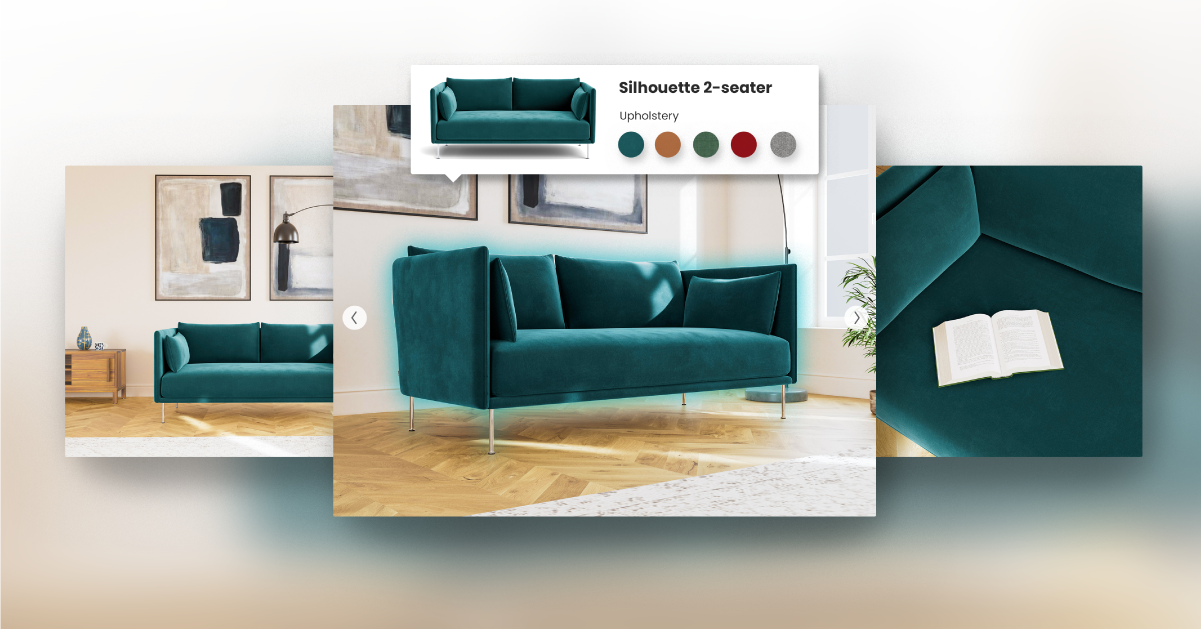

TL;DR: The traditional search bar forces customers to translate their needs into rigid metadata, which kills conversions. By combining natural language AI with 3D product configuration, brands can bypass search filters and instantly render the exact custom product a shopper describes.
Key points:
-
The End of Filters: Traditional search causes decision fatigue. AI parses natural language to understand spatial constraints and style preferences instantly.
-
Visual Orchestration: Generative AI is best used to assemble 3D assets into custom, photorealistic products on the fly, moving far beyond text-based chatbots.
-
Closing the Inspiration Gap: Shoppers can describe their space or upload a photo to see a 3D product configured and styled for their specific room.
The Tyranny of the Filter
"Showing 1-24 of 4,000 results."
That single line of text sits at the top of nearly every furniture category page on the internet. It is the quiet symbol of how broken modern product discovery has become.
The brand has done the hard work of producing a deep, beautifully crafted catalog. The customer has done the hard work of showing up with intent and a budget. Then, we ask them to chew through forty pages of grid view and a dozen dropdown filters.
We hope they stumble across the right piece before their patience runs out. It almost never works.
Endless scrolling is a reliable producer of decision fatigue on the open web. Filters by dimension, style, and fabric look helpful on paper. But they require the user to translate a fuzzy desire into precise metadata fields the brand happened to tag correctly.
The cognitive load is heavy, and most shoppers simply give up. Cart abandonment goes up, sessions go down, and conversion stays flat.
The future of furniture e-commerce is not searching. It is configuring. By combining natural language AI with 3D modular furniture configurator software, brands can move past the search bar entirely.
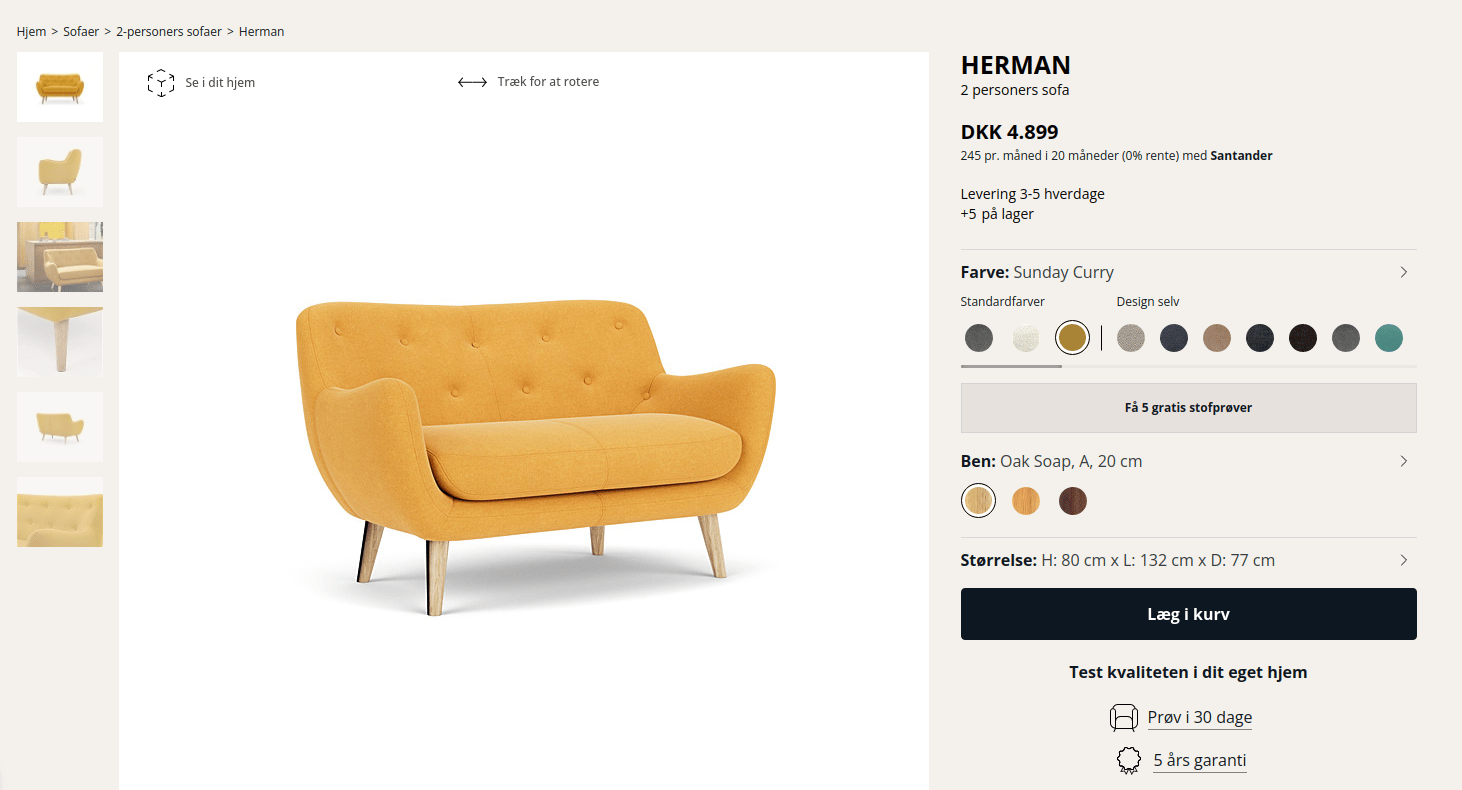

"We can see that when consumers enter the design-your-own universe, there are significantly higher conversion rates... Once they step in that universe and start playing around, there’s a significantly higher likelihood that they will end up buying."
— Simon Peschcke-Køedt, CMO, Sofacompany
The screen stops being a list to scroll through. It becomes a workshop that produces exactly what the customer asks for, on demand, in seconds.
From Keyword Search to Contextual Assembly
Traditional search engines fundamentally do not understand how human beings shop for furniture. They match keywords against product titles, descriptions, and structured attributes.
They do not understand spatial constraints or interior design vocabulary. They miss the layered, slightly contradictory nuances that show up in every real shopping conversation.
A shopper types "comfy couch for a small dark apartment" and gets back a grid of irrelevant results. The word "small" returns a few items tagged as compact. The word "dark" pulls up sofas in charcoal upholstery, which is the exact opposite of what the shopper actually wanted.
The word "comfy" is so subjective that the search engine ignores it. The shopper closes the tab and tries again somewhere else.
A modern AI layer parses that prompt the way a knowledgeable salesperson would. It translates the prompt into a real spec:
-
"Small": Maps to specific dimensional constraints relative to the user's room.
-
"Dark": Describes the space, meaning the recommended sofa should be lighter to create visual contrast.
-
"Comfy": Maps to deep seating, soft fill, performance fabrics, and frame profiles that score high on comfort metrics.
That is half of the breakthrough. The other half is what happens after the parse.
Instead of returning a list of links, the AI hands the spec to a 3D buying software and configurator. The system assembles and renders the perfect product on screen in real time.
The shopper sees a single piece, custom-built to their stated needs, ready to rotate, customize, and buy. The search experience becomes a building experience.
The Generative Interface
A myth has taken hold in many marketing organizations about where generative AI belongs in the commerce stack. It usually sounds like this: "Generative AI is great for writing product descriptions or running a chatbot. We will plug it into customer service and call it a day."
That framing leaves the most valuable use case on the table.
The visual shift: The highest-leverage application of AI in commerce is not text. It is visual orchestration.
AI acts as a digital interior designer. It uses your 3D assets as building blocks to show the customer what they need, rather than just telling them about it. Description is a fallback for systems that cannot render.
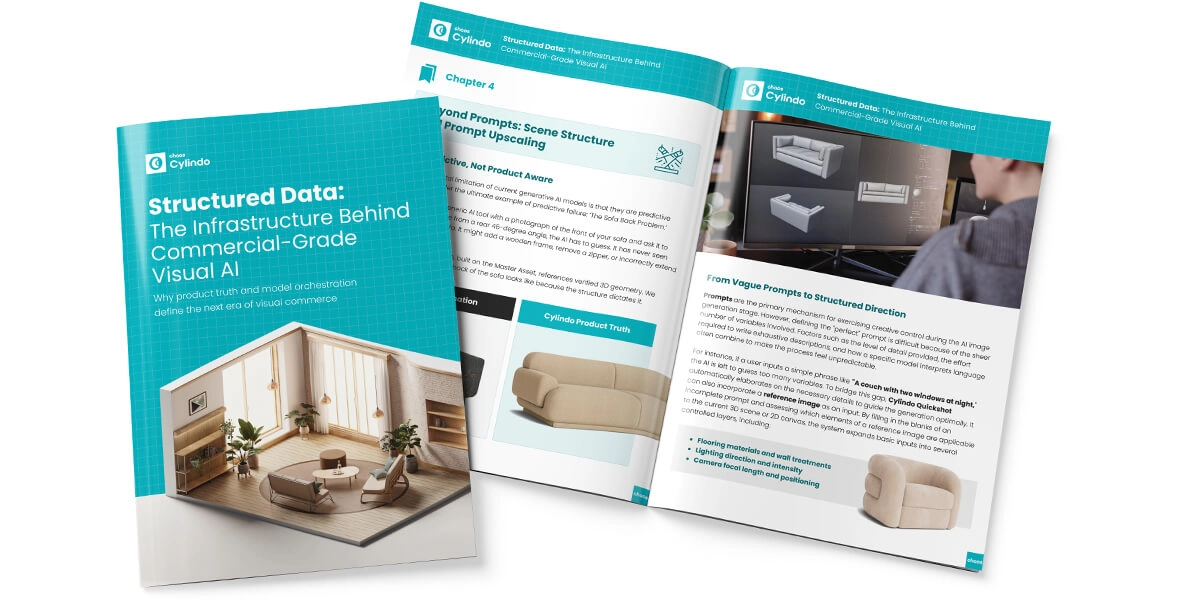
This is where perfectly structured, modular 3D assets become the fuel for a generative interface. Because digital twins are built on consistent logic, an AI agent can interact directly with the platform's APIs to construct and recommend visual configurations on the fly.
Proof of Impact: Life Outdoor Living
+75% Online Revenue & +44% Average Order Value (AOV)
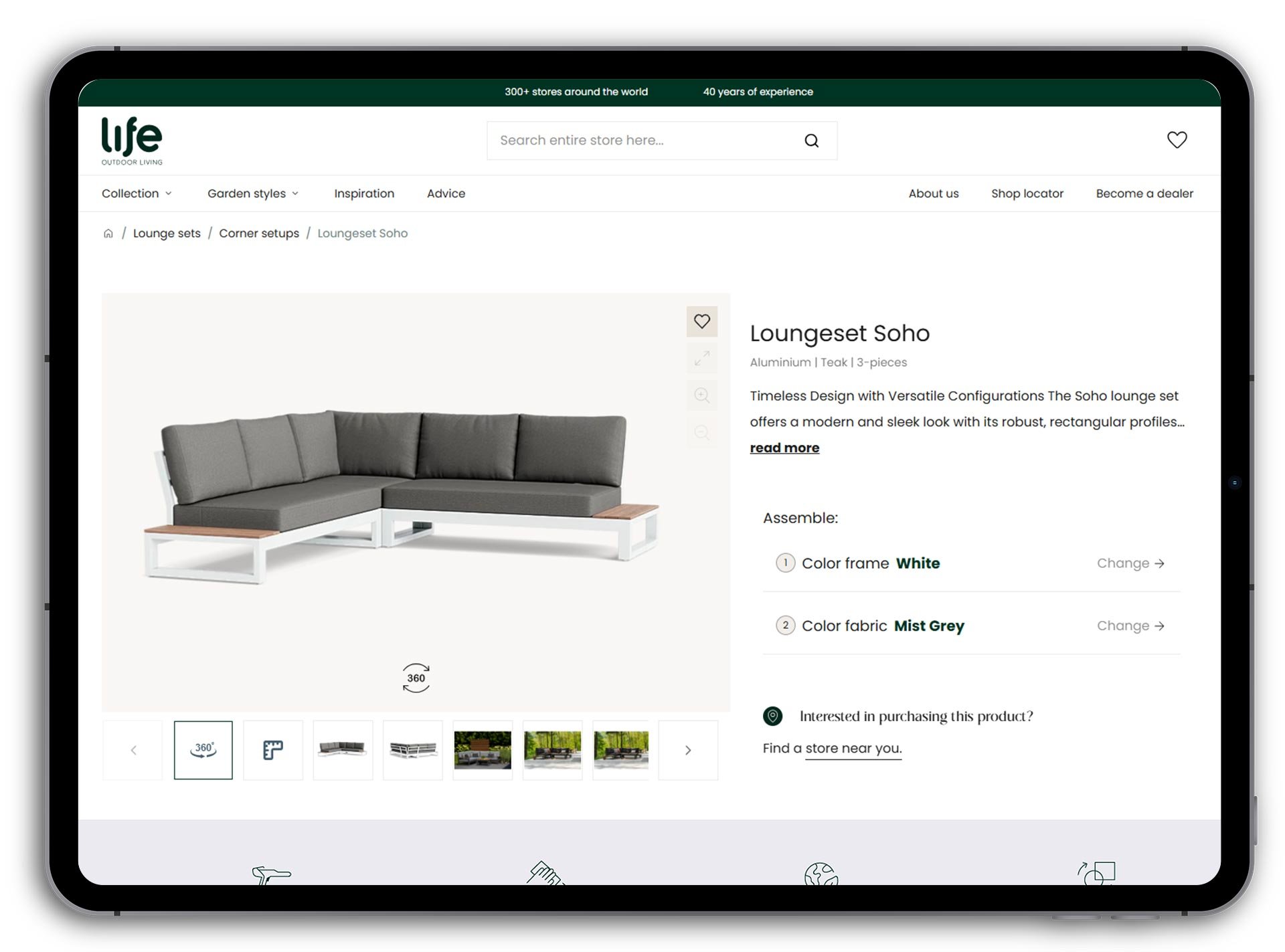
By replacing static imagery with Cylindo's high-fidelity 3D visualization, Life Outdoor Living brought the interactive showroom experience directly to their digital storefront, proving that visual configuration drives larger, more confident purchases. Read the case study here.
The model frame, upholstery, legs, cushions, and room scene are all addressable through code. The AI calls the API, and the platform produces the photoreal answer.
That structural rigor makes generative experiences trustworthy at the merchandising level. With it, you get a real piece from your catalog, rendered to spec, ready to add to cart.
The Generative Room
One of the most painful gaps in modern shopping is the disconnect between inspiration and purchase. A customer sees a beautiful living room on Pinterest and wants it.
They open three or four retailers and manually piece together a look across dozens of product pages. They get overwhelmed and end up buying nothing. The journey from inspiration to checkout is long and filled with friction.
Visual guided selling closes that gap. The customer uploads a photo of their living room or describes their space, and the AI takes over.
It infers the room's dimensions, lighting, and style. It selects an appropriate product type and configuration from the catalog. It renders a dimensionally accurate 3D piece, dropped right into the context the customer cares about.
Picture the scenario. A shopper types into a prompt box: "I need a modular sectional that fits a 100-inch wall, kid-friendly fabric, in a Scandinavian style."
Instead of returning a list of blue links, the system instantly renders a 3D model of a three-seater sectional in performance fabric with light oak legs. The shopper rotates it. They view it in web-native augmented reality against their actual wall.
They decide they want the chaise on the left instead of the right, and the AI swaps it in real time. Total session time from prompt to purchase is under three minutes. No filter dropdowns were touched.
Selling the Solution, Not the SKU
The search bar is becoming obsolete. The brands that will define the next era of furniture e-commerce are the ones that can translate a customer's complex needs into a photorealistic 3D reality.
You stop selling SKUs and start selling solutions. The catalog is no longer a list of pre-built products waiting to be discovered.
It is a deep set of capabilities that an AI assembles into exactly what the shopper needs, rendered with the fidelity required to close a high-ticket sale.
Do not make your customers search for the perfect product. Build it for them, right before their eyes.

Frequently Asked Questions
How does generative AI improve furniture discovery?
Generative AI moves discovery away from keyword-based search filters. Instead of manually clicking through pages, shoppers describe their room and style in plain English. The AI parses the context and instantly assembles a custom 3D product that matches their exact specifications.
Why is traditional keyword search failing in furniture e-commerce?
Keyword search engines cannot understand spatial constraints or interior design nuances. They match exact text tags, which often leads to irrelevant results when shoppers use subjective terms like "comfy" or context-heavy phrases like "for a small dark apartment."
What is the role of 3D assets in AI shopping experiences?
Structured 3D assets act as the building blocks for generative interfaces. Instead of relying on AI to generate hallucinated images, the system uses APIs to assemble real, accurate 3D product components from the brand's catalog, ensuring the final visual is a product that can actually be purchased.