---
title: Why Furniture Brands with Structured Product Data Will Own AI Commerce in 2027
description: The brands that build structured product data infrastructure in 2026 will be the brands AI agents recommend in 2027. Here is the competitive window argument and what the infrastructure actually looks like.
image: https://blog.cylindo.com/hubfs/structured%20data1.png
---
[  Cylindo Logo](https://www.cylindo.com/)
- Platform
Overview
- [How it works](https://www.cylindo.com/how-it-works/)
Core Platform
- [Asset Hosting A visual source of truth for every product.](https://www.cylindo.com/platform/core/#asset-hosting)
- [Content Creation Produce channel-ready content at catalog scale.](https://www.cylindo.com/platform/core/#content-creation)
- [Commerce Tools Turn product pages into digital showrooms.](https://www.cylindo.com/platform/core/#commerce-tools)
- [Distribution Compose, push, and measure across channels.](https://www.cylindo.com/platform/core/#distribution)
Bundles
- [Lifestyle Add-on 3D and AI lifestyle imagery tools - (Best for visuals at scale)](https://www.cylindo.com/platform/lifestyle/)
- [3D Design Customize multi-component or multi-product bundles in real time. - (Best for e-commerce)](https://www.cylindo.com/platform/3d-design/)
- [Compare bundles Check which bundle fit your needs](https://www.cylindo.com/platform/compare-bundles/)
[](https://cta-service-cms2.hubspot.com/web-interactives/public/v1/track/click?encryptedPayload=AVxigLI6OOO%2FX2J5LDxKXkS4hv6vtKaU6HSjeVDZjXWZcmceLj8daUydus447qAu%2BlJ559eJAETFdNThy3brmpc78RjSqK91TBGV3DRXWAT9CYaUwQTfpUcS4gyKy0BGxMrUXfiXXfPcuqDC4YFL2Q4t8zSqa5LBCOoe2%2B239nHYL4sjznAmPVn12nKAd0a4eGw%3D&portalId=4585441)
- Use cases
By outcome
- [Convert more shoppers](https://www.cylindo.com/use-cases/outcome/#convert-more)
- [Scale content creation](https://www.cylindo.com/use-cases/outcome/#scale-content)
- [Win across every channel](https://www.cylindo.com/use-cases/outcome/#win-across-every-channel)
By vertical
- [Furniture & home furnishings](https://www.cylindo.com/use-cases/verticals/#home-furniture)
- [Kitchen & bath](https://www.cylindo.com/use-cases/verticals/#kitchen-bath)
- [Lighting](https://www.cylindo.com/use-cases/verticals/#lighting)
- [Cabinetry](https://www.cylindo.com/use-cases/verticals/#cabinetry)
- [Outdoor living](https://www.cylindo.com/use-cases/verticals/#outdoor-living)
- [Contract & commercial](https://www.cylindo.com/use-cases/verticals/#contract-commercial)
By team
- [Creative](https://www.cylindo.com/use-cases/team/#creative)
- [Marketing](https://www.cylindo.com/use-cases/team/#marketing)
- [Digital & E-commerce](https://www.cylindo.com/use-cases/team/#digital-e-commerce)
###### [ Boosts online revenue +75% and AOV +44% with Cylindo Read more \>](https://cta-service-cms2.hubspot.com/web-interactives/public/v1/track/click?encryptedPayload=AVxigLKugaXLIJ%2FBi8rQ6ZH3KScymjpgFZMcslnX61buCaP7eztqyM%2FImxHLX0dtAnupUJVVBxkGawM3jYjCADACR7YiwNpGfaglek7MHXGRWftKwG7GteizyxZu8v4WpsEWrFZus%2Fqgv%2Fptk4DWBS%2FxWd2Sz72hNE9rvQIpn%2FyvuOFQoOyDEsBtEbUQ7wUe8xfZasMvt6gQZf%2FMx0eDGfZRZoo6%2BBs%3D&portalId=4585441)
- Customers
Customers
- [Customer Stories](https://www.cylindo.com/customer-case-studies/)
- [Customer Showcase](https://www.cylindo.com/customers/customer-showcase/)
Who we serve
- [B2B](https://www.cylindo.com/customers/who-we-serve/#b2b)
- [B2C](https://www.cylindo.com/customers/who-we-serve/#b2c)
###### [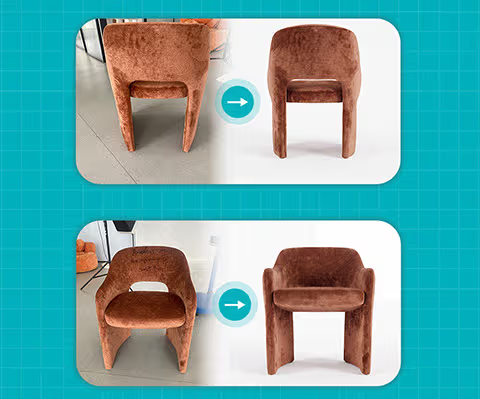 Introducing AI Master Assets Send four product photos and Cylindo produces four studio-quality silo shots in your chosen material, anchored to a 3D asset, with no content creation fee. Read more \>](https://cta-service-cms2.hubspot.com/web-interactives/public/v1/track/click?encryptedPayload=AVxigLKSbU1o5Ysj%2BcPHemzhD%2BQkYuIdvXHUOoj2SSm65frD8BvU5oP5VLFHOkvUADHGADgl04yRtO%2F3Jqiaet2IuCz1XbqguPoyO3c92XWtIN8Q898MYXZrbe2u9R7UN8Ce1CUFr5%2BOkaGZ22CGY8pDTNfyy3htJSI3nfzs96PEjUL2WpHb6vVuwzjqYeFJvRYAJpVWvH4l8jP9&portalId=4585441)
- Resources
Learn
- [Blog](https://blog.cylindo.com)
- [Cylindo library](https://www.cylindo.com/cylindo-content-library/)
Evaluate
- [ROI calculator](https://www.cylindo.com/roi-calculator/)
- [AI Master Assets test](https://www.cylindo.com/ai-master-assets-test/)
- [Business Impact](https://www.cylindo.com/business-impact/)
- [Free custom 3D and AI report](https://www.cylindo.com/custom-report/)
Support
- [Help center](https://learn.cylindo.com/help)
- [Ask support](https://learn.cylindo.com)
- [Change log](https://learn.cylindo.com/changelog)
###### [ Modern Search Discoverability Guide Learn how Google's 2026 AI search updates affect furniture discovery—and what to do to keep your products visible in AI-powered search. Download \>](https://cta-service-cms2.hubspot.com/web-interactives/public/v1/track/click?encryptedPayload=AVxigLJEl7T5dyLLkk%2FWEwwy6TlSBb9kSsYlkDUJ6tN9HhhUvn2hsLUaVYADFKjCAZUMYOr%2BPNOJgpkY2PJicVb3%2FGWl538Jmd3qJuCz8hf19svC47f2bjpQkoTlSgztHrzKcSDNaxvFrc0rZaFt1%2F75i9%2FVuns6K6Hkjfj7dt3UXOSlN1T4Ca%2Bt77aBq2Sgij0EtMCEjYZ%2Bc6O4olPgSsi2vkIcBzleG5bv9eDOO4D%2B%2BwNV2TMwtKv4x3g%3D&portalId=4585441)
- [Book demo](https://www.cylindo.com/book-meeting/)
- [Receive pricing](https://www.cylindo.com/receive-pricing/)
- [Login](https://app.cylindo.com/login)
- Platform
- [How it works](https://www.cylindo.com/how-it-works/)
- [Asset Hosting A visual source of truth for every product.](https://www.cylindo.com/platform/core/#asset-hosting)
- [Content Creation Produce channel-ready content at catalog scale.](https://www.cylindo.com/platform/core/#content-creation)
- [Commerce Tools Turn product pages into digital showrooms.](https://www.cylindo.com/platform/core/#commerce-tools)
- [Distribution Compose, push, and measure across channels.](https://www.cylindo.com/platform/core/#distribution)
- [Lifestyle Add-on 3D and AI lifestyle imagery tools - (Best for visuals at scale)](https://www.cylindo.com/platform/lifestyle/)
- [3D Design Customize multi-component or multi-product bundles in real time. - (Best for e-commerce)](https://www.cylindo.com/platform/3d-design/)
- [Compare bundles Check which bundle fit your needs](https://www.cylindo.com/platform/compare-bundles/)
- Use cases
- [Convert more shoppers](https://www.cylindo.com/use-cases/outcome/#convert-more)
- [Scale content creation](https://www.cylindo.com/use-cases/outcome/#scale-content)
- [Win across every channel](https://www.cylindo.com/use-cases/outcome/#win-across-every-channel)
- [Furniture & home furnishings](https://www.cylindo.com/use-cases/verticals/#home-furniture)
- [Kitchen & bath](https://www.cylindo.com/use-cases/verticals/#kitchen-bath)
- [Lighting](https://www.cylindo.com/use-cases/verticals/#lighting)
- [Cabinetry](https://www.cylindo.com/use-cases/verticals/#cabinetry)
- [Outdoor living](https://www.cylindo.com/use-cases/verticals/#outdoor-living)
- [Contract & commercial](https://www.cylindo.com/use-cases/verticals/#contract-commercial)
- [Creative](https://www.cylindo.com/use-cases/team/#creative)
- [Marketing](https://www.cylindo.com/use-cases/team/#marketing)
- [Digital & E-commerce](https://www.cylindo.com/use-cases/team/#digital-e-commerce)
- Customers
- [Customer Stories](https://www.cylindo.com/customer-case-studies/)
- [Customer Showcase](https://www.cylindo.com/customers/customer-showcase/)
- [B2B](https://www.cylindo.com/customers/who-we-serve/#b2b)
- [B2C](https://www.cylindo.com/customers/who-we-serve/#b2c)
- Resources
- [Blog](https://blog.cylindo.com)
- [Cylindo library](https://www.cylindo.com/cylindo-content-library/)
- [ROI calculator](https://www.cylindo.com/roi-calculator/)
- [AI Master Assets test](https://www.cylindo.com/ai-master-assets-test/)
- [Business Impact](https://www.cylindo.com/business-impact/)
- [Free custom 3D and AI report](https://www.cylindo.com/custom-report/)
- [Help center](https://learn.cylindo.com/help)
- [Ask support](https://learn.cylindo.com)
- [Change log](https://learn.cylindo.com/changelog)
- [Book demo](https://www.cylindo.com/book-meeting/)
- [Receive pricing](https://www.cylindo.com/receive-pricing/)
- [Login](https://app.cylindo.com/login)
[Back to Blog](https://blog.cylindo.com/all)
# Why Furniture Brands with Structured Product Data Will Own AI Commerce in 2027

[Jen Rasmussen](https://blog.cylindo.com/author/jen-rasmussen) Published: September 17, 2026

> TL;DR: AI commerce is already here. The furniture brands positioned to benefit as it grows will be the ones with structured product data that AI agents can read, evaluate, and recommend. Brands that build that foundation now create a compounding advantage as AI models, shopping experiences, and commerce channels continue to evolve.
## The window is now
AI is changing how shoppers discover and evaluate products, including high-consideration purchases like furniture. As AI shopping agents become a larger part of the buying journey, brands need product information that machines can interpret accurately.
The gap between brands with structured, machine-readable product data and brands without it is widening. Building that foundation in 2026 gives furniture brands a head start as AI-driven discovery grows. Waiting until 2028 means catching up to brands that have already been indexed, evaluated, and recommended for two years.
The constant in the technology stack should be the structured product data feeding those experiences. AI models will continue to change. Structured product data, built correctly, remains useful across successive generations of AI.
For furniture, that data goes well beyond a product title, description, and image. An AI shopping agent may need to understand dimensions, materials, available configurations, pricing, availability, and which combinations are actually valid before it can evaluate whether a product meets a shopper's requirements.
An AI-ready furniture catalog makes those attributes machine-readable and consistently available across channels.
## What structured product data actually is
Structured product data gives machines a consistent way to understand the products in a furniture catalog. For furniture brands, several layers are particularly important.
- Machine-readable geometry makes accurate product dimensions available as structured fields rather than requiring a system to infer them from an image or marketing description.
- PBR material metadata describes properties such as fiber content, care codes, and surface characteristics in a structured format.
- Configuration logic defines the relationships between product options. It encodes which modules combine, which fabrics pair with which frames, and which dimensions are valid for a particular configuration. An AI agent cannot execute a visual configurator at query time. It needs this as structured data.
- Omnichannel consistency ensures that the same verified product information is available at every endpoint an AI agent or shopper may access.
- ProductGroup schema provides a structured way to represent product families and variants, including attributes such as variesBy and hasVariant. This gives AI systems a machine-readable representation of the relationships within a configurable product family.
Together, these elements create a structured product foundation that supports both visual experiences for shoppers and machine-readable experiences for AI.
## The infrastructure is buildable at scale today
The scale required for furniture AI commerce can already be seen in commercial deployments.
Landscape Forms manages eight product families, more than 70 3D assets, and more than five million valid specification combinations. Its structured product foundation supports more than 2,500 configurations and has contributed to a 14.58% engagement lift. That scale matters for configurable furniture. An AI agent evaluating a product needs to understand which options can actually exist together. A catalog containing millions of possible combinations requires configuration logic that can be queried consistently.
MAKE Nordic provides another example. Customization adoption increased fivefold, with custom orders growing from 10% to 50%, alongside year-over-year revenue growth. The same configuration logic that helps a shopper understand available choices provides the structured relationships needed for AI systems to evaluate configurable products.
Cozey demonstrates the importance of maintaining one verified source across channels. Its product experiences are [distributed from a single verified 3D Master Asset](https://blog.cylindo.com/introducing-ai-master-assets), eliminating version drift between what a human shopper sees and what an AI agent reads about the same product.
Felix Robitaille, Director of Marketing at Cozey:
> We opted for Cylindo over other vendors due to its remarkable fast loading speed, exceptional quality of renders, and agility in keeping up with our fast-paced projects.
#### Proof of Scale: Landscape Forms
5M+ Combinations. 2,500+ Custom Configurations. 14.58% Engagement Lift.
Eight product families, 70+ 3D assets, five million valid specification combinations: all structured, all machine-readable, all queryable by AI agents and human specifiers simultaneously. The infrastructure for AI commerce does not need to be built for AI. It needs to be built correctly. The rest follows.
Read the full case study [here](https://www.cylindo.com/customer-case-studies/landscape-forms/).
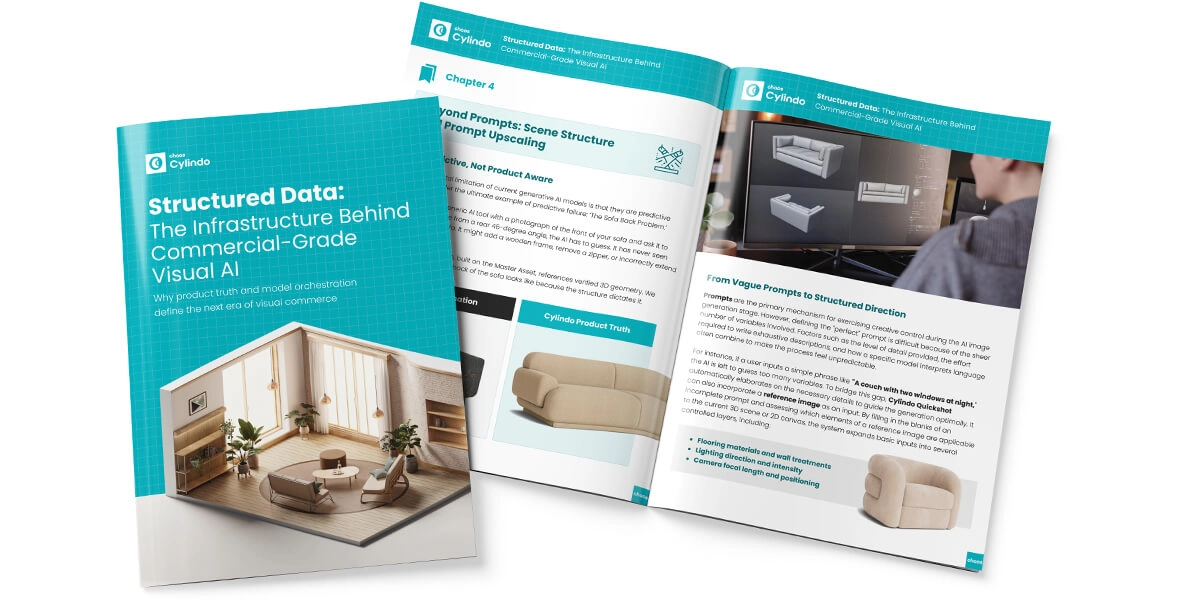
Free Ebook
### Structured Data: The Infrastructure Behind Commercial-Grade Visual AI
The full framework on why structured product data is the constant in your technology stack, and why the brands building it now will be the ones AI agents recommend in 2027.
[Get the Ebook](https://www.cylindo.com/cylindo-content-library/e-books/structured-data-infrastructure-behind-commercial-grade-visual-ai/?utm_source=organic&utm_medium=blog&utm_campaign=structured-data-2027&utm_content=inline-ebook-cta)
## Structured infrastructure creates a compounding advantage
A structured catalog becomes more valuable as brands expand it and as the systems consuming that data become more capable.
Once the underlying infrastructure is established, new SKUs can be added to the same verified library. The foundation is already in place, making it easier to expand structured product coverage over time without rebuilding the data layer for every new product.
AI agents will also become more capable of interpreting structured product information. Improvements in those systems increase the ways a well-structured catalog can be discovered, evaluated, and recommended. A brand that builds the foundation now benefits from every improvement in agent capability automatically. A brand that delays falls further behind every quarter agents get more capable at finding the brands that have already done the work.
Today, the infrastructure required to make product attributes accessible to AI systems is itself a competitive differentiator. When structured product data becomes standard across furniture, product quality, brand strength, price, and customer experience will again be the primary factors. The brands that move first have more time to build catalog depth, improve data quality, and extend structured coverage before that window closes.
## What acting now looks like
Preparing for furniture AI commerce starts with auditing the existing catalog against five AI agent evaluation criteria: geometry, materials, configuration logic, pricing consistency, and availability accuracy.
From there, brands can [build a verified 3D Master Asset library](https://blog.cylindo.com/introducing-ai-master-assets) as the structured product foundation. The [Cylindo Content API](https://www.cylindo.com/platform/products/export/) distributes from a single verified source across commerce channels, helping maintain consistency wherever product data is consumed. Implementing ProductGroup schema with variesBy and hasVariant exposes product families and configuration options in a machine-readable format.
The result is an infrastructure layer that supports the product wherever it needs to appear, from today's PDP and configurator to emerging AI shopping experiences.
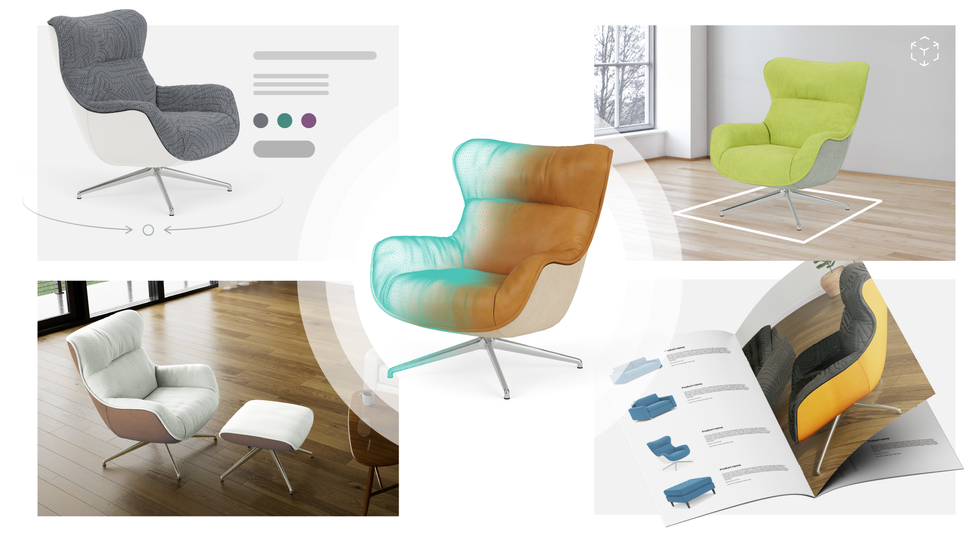
Platform Demo
### See how Cylindo builds a structured, AI-ready product foundation
Book a platform demo to explore how Cylindo's asset creation, configuration logic, and Content API work across your furniture catalog.
[Book a Demo](https://www.cylindo.com/book-meeting/?utm_source=organic&utm_medium=blog&utm_campaign=structured-data-2027&utm_content=inline-demo-cta)
### Frequently Asked Questions
#### Why will structured product data determine AI commerce outcomes in 2027?
AI shopping agents evaluate products using information such as dimensions, material specifications, configuration options, pricing, and availability. Structured product data makes those attributes machine-readable, giving AI systems the information needed to evaluate whether a product meets a shopper's requirements. As AI-driven product discovery grows, brands with structured catalogs will be better positioned to participate in those recommendation and evaluation experiences.
#### What structured product data do furniture brands need to be AI-ready?
Furniture brands need machine-readable geometry, PBR material metadata, configuration logic, consistent pricing and availability across channels, and structured relationships between product variants. ProductGroup schema with variesBy and hasVariant makes product families and configuration options traversable by AI systems without requiring a visual interface to be executed.
#### How long does it take to build structured product data infrastructure?
The timeline depends on catalog size and existing 3D asset coverage. Cylindo builds verified 3D Master Assets from CAD files or physical samples during a managed onboarding phase. Once live, the Content API distributes structured product information across channels from one verified source. Brands such as Cozey deploy across multiple channels from the same library, and new SKUs can be added incrementally rather than requiring a full catalog rebuild.
#### Is structured product data the same as having a 3D visualizer on the product page?
No. A 3D visualizer is a customer-facing experience. Structured product data is the machine-readable layer supporting the product, including geometry, material metadata, configuration relationships, pricing, availability, and variant structure. This gives AI systems access to product information without depending on the visual interface itself.

## Jen Rasmussen
Jen Rasmussen leads the global marketing organization at Cylindo, where she is responsible for strategy, brand, and demand generation. With more than 15 years in B2B SaaS marketing, she brings deep expertise in optimizing operations, enabling sales, and delivering measurable growth.
## [ Free test Get studio-quality product visuals in 24 hours. Try AI Assets](https://www.cylindo.com/ai-master-assets-test/)
## Subscribe to our monthly newsletter.
Share
## [ Previous What Is a Visual PIM? How Cylindo Centralizes and Distributes Your Product Visuals](https://blog.cylindo.com/what-is-a-visual-pim-how-cylindo-centralizes-and-distributes-your-product-visuals/)
## [ Next How Luxury Furniture Brands Are Using 3D to Win Premium Positioning Online Without Studio Photography](https://blog.cylindo.com/how-luxury-furniture-brands-are-using-3d-to-win-premium-positioning-online-without-studio-photography/)
## Related Posts
[](https://www.chaos.com/)
Platform
- [How it works](https://www.cylindo.com/how-it-works/)
- [Core platform](https://www.cylindo.com/platform/core/)
- [Lifestyle bundle](https://www.cylindo.com/platform/lifestyle/)
- [3D design bundle](https://www.cylindo.com/platform/3d-design/)
- [Compare bundles](https://www.cylindo.com/platform/compare-bundles/)
Products
- [Augmented reality](https://www.cylindo.com/platform/products/augmented-reality/)
- [Curator](https://www.cylindo.com/platform/products/curator/)
- [Create](https://www.cylindo.com/platform/products/export/)
- [Analytics](https://www.cylindo.com/platform/products/analytics/)
- [Dimension shots](https://www.cylindo.com/platform/products/dimension-shots/)
- [Quickshot](https://www.cylindo.com/platform/products/quickshot/)
- [Studio](https://www.cylindo.com/platform/products/studio/)
- [Modular Designer](https://www.cylindo.com/platform/products/modular-designer/)
Company
- [About](https://www.cylindo.com/about-us/)
- [Leadership](https://www.cylindo.com/about-us#leadership)
- [Contact us](https://www.cylindo.com/about-us#contact-us)
- [Careers](https://careers.chaos.com/)
- [News](https://www.chaos.com/press)
Resources
- [Customer Success Stories](https://www.cylindo.com/customers/customer-stories/)
- [Customer Showcase](https://www.cylindo.com/customers/customer-showcase/)
- [Learning center](https://learn.cylindo.com/help)
- [Cylindo Blog](https://blog.cylindo.com)
- [Cylindo Library](https://www.cylindo.com/cylindo-content-library/)
- [Furniture Briefings](https://resources.cylindo.com/furniture-briefings-subscribe)
## Follow us
-
-
-
-
© 2026 Cylindo. All Rights Reserved.
- [Cookie policy](https://www.cylindo.com/cookies-policy/)
- [Privacy policy](https://www.cylindo.com/privacy/)