

TL;DR: Generative AI models are trained to predict pixels, not to understand products. Left alone, they will invent geometry and hallucinate material details to produce an image that looks convincing but is not accurate. Cylindo's ebook, Structured Data: The Infrastructure Behind Commercial-Grade Visual AI, lays out why structured 3D product data, not the AI model itself, is what actually makes a visual trustworthy at commerce scale.
Key points:
-
Generic AI prioritises creative flexibility over product accuracy. It will happily invent geometry or hallucinate structural and material details to create a mathematically pleasing image, even when that image is wrong.
-
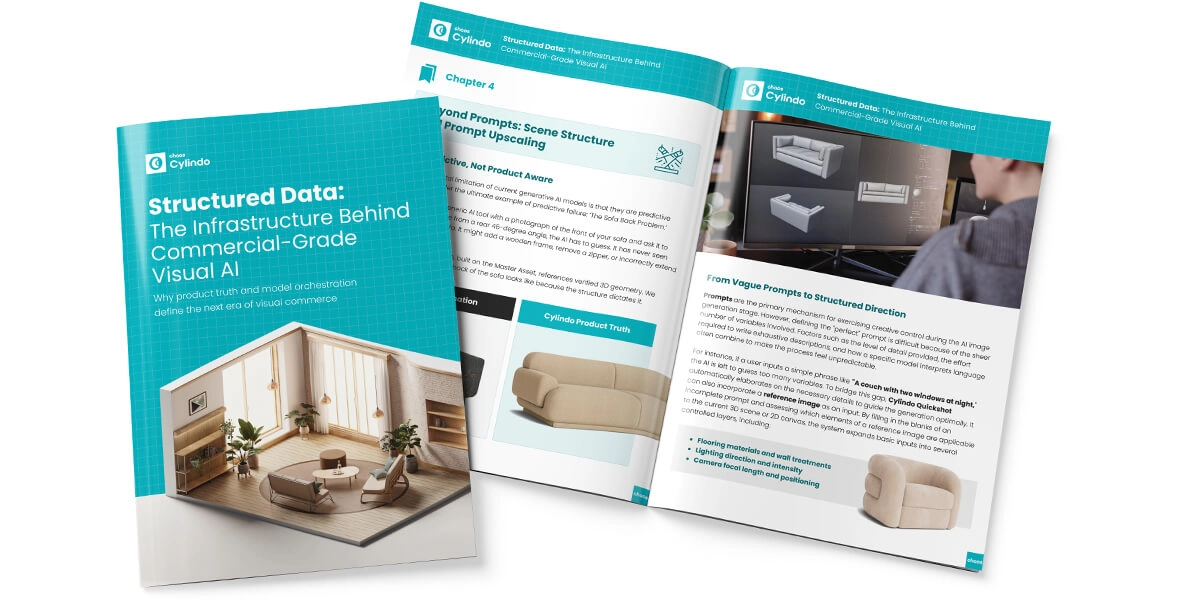
The clearest illustration is what the ebook calls the Sofa Back Problem. Ask a generic AI tool to generate a rear 45-degree view of a sofa it has only ever seen from the front, and it has to guess. It might add a wooden frame that does not exist, remove a zipper that does, or incorrectly extend the upholstery.
-
For premium furniture, a visual that is merely close enough is a conversion killer and a direct threat to brand equity. Accurate representation has been proven to double ecommerce sales and reduce buyer's remorse returns by up to 35%.
-
The constant in your visual commerce stack should never be the AI model. Models change every twelve months. The constant must be the structured product data that feeds them.
Generic AI is a guessing engine, not a product expert
Generative models are trained to predict pixels from vast datasets. They do not inherently understand products. They understand patterns. Left to operate on their own, these models prioritise creative flexibility over product fidelity, and they will invent geometry or hallucinate structural and material details whenever doing so produces a more visually convincing result.
Consider a simple prompt: place a velvet mid-century armchair in a sunlit loft. A generic AI tool will generate a stunning loft and a beautiful chair. On closer inspection, though, the velvet might render like suede, the scale of the chair might be dwarfed by the surrounding architecture, or the specific curvature of the wooden armrest (the exact detail that justifies the chair's premium price point) might be hallucinated into an entirely different shape.
For a premium furniture brand or a high-ticket consumer goods manufacturer, a visual that is merely close enough is more than a marketing failure. It is a conversion killer, and it puts brand equity directly at risk. As Cylindo's Structured Data ebook puts it: generic AI platforms can subtly alter a product in ways the naked eye might miss at first glance but that a customer will instantly recognise the moment the real item arrives.
The Sofa Back Problem
The clearest example of where predictive AI breaks down is what Cylindo's ebook calls the Sofa Back Problem. Provide a generic AI tool with a photograph of the front of a sofa and ask it to generate a rear 45-degree view, and the AI has to guess. It has never seen the back of that sofa. It might add a wooden frame, remove a zipper, or incorrectly extend the upholstery, all while producing an image that looks polished and confident.
A production-grade system built on a true 3D Master Asset does not have this problem, because it references verified geometry rather than guessing. The back of the sofa is already known, because the underlying structure dictates it rather than the model inferring it from a single angle.
That distinction between structured product truth and AI inference is what separates aesthetic AI tools built for conceptual brainstorming from visual AI infrastructure that can be trusted to scale a catalog of thousands of complex, highly customisable SKUs without a single misplaced seam turning into a costly return.
Proof of Impact: Yardistry
Doubled Ecommerce Sales Year Over Year.
By anchoring its visual strategy in structured, accurate 3D data rather than open-ended AI generation, Yardistry doubled its ecommerce sales year over year using Cylindo's Viewer and AR solution. Every rendered angle of every product reflects verified geometry and materials rather than an AI's best guess, turning visual accuracy into a direct, measurable revenue driver rather than a creative nice-to-have.
Read the full case study here.
Accuracy pays off on returns too. Ann Gish used structured visualization to give Wayfair shoppers a confident, accurate view of its products before purchase, and saw buyer's remorse returns drop by 35%.
"We've seen a 35% reduction in buyer's remorse returns on Wayfair, which reflects customers' growing confidence when making purchase decisions."
— Jane Gish, CEO, Ann Gish
Why product data on file is not the same as AI-ready data
Most large product organisations already sit on enormous volumes of product data, having invested heavily in ERP and CRM systems that track SKUs and manufacturing origins in detail. That data is not the same as structured data built for visual AI, and the gap between the two is where most enterprise AI rollouts quietly fail.
A spreadsheet listing a sofa's dimensions alongside a text description of its mocha velvet upholstery is genuinely useful to a logistics team. It tells a generative AI model nothing about how light should wrap around a curved, tufted armrest, or how a specific fabric weave should cast micro-shadows in direct sunlight. Fed only that kind of unstructured description, an AI model searches its training data and generates an amalgamation of other brands' products rather than the actual item on the shelf.
A true Master Asset closes that gap. It functions as a 1:1 digital twin of the physical product, built from four critical layers: Configuration Logic (the rules governing how the product can be assembled), Physically Based Rendering Materials (how every surface interacts with light), Dimensions (real-world scale to the millimetre per configuration), and Geometry (the structural mesh defining the exact physical shape). Together these layers give the AI system a verified source of truth to reference instead of guessing, which is what allows a brand to generate thousands of accurate product images without the product's appearance drifting. The full breakdown of what belongs in that data package, and what a platform needs architecturally to enforce it, is covered in detail in the ebook.
Why brands are moving away from single-model AI tools
The AI sector is evolving quickly enough that today's state-of-the-art model will inevitably become tomorrow's legacy technology. Many software vendors have married their platforms to a single underlying model, and when that model falls behind, those vendors are trapped. Staying competitive means rebuilding backend architecture entirely, which creates disruption for every client relying on it.
In practice, this leaves ecommerce and marketing teams testing one tool for a campaign, experimenting with another for social media, and watching their product data fragment across both. Cylindo's ebook argues the fix is model orchestration rather than model lock-in: pairing structured product data with whichever generative engine performs best for a specific task, so the constant in a brand's visual commerce stack is the structured product data itself, not any single AI model underneath it.
Why this extends beyond a single image
3D data is not a step being phased out by generative AI. It is the infrastructure generative AI depends on, and it matters beyond static lifestyle imagery. Augmented reality product placement and spatial computing interfaces require 3D models to function at all. As the ebook puts it: you cannot place a 2D image into a physical living room. Brands that abandon 3D in favour of pure AI image generation risk locking themselves out of that shift entirely.
The payoff for getting this right shows up directly in conversion behaviour. Accurate materials increase a product's perceived value. Accurate scale reduces purchase anxiety. Both together reduce returns, which is where the revenue impact compounds fastest for high-ticket categories like furniture. AI alone generates images. Structured data generates images consumers trust. The difference between those two outputs is the difference between a content engine that builds brand equity and one that quietly erodes it.
Frequently Asked Questions
What is the Sofa Back Problem in AI-generated product visuals?
The Sofa Back Problem describes what happens when a generic AI tool is asked to generate a view of a product it has never actually seen, such as the rear of a sofa when only given a front-facing photo. Because the AI has no verified geometry to reference, it guesses, and often gets details wrong: adding a frame that does not exist, removing a zipper that does, or extending the upholstery incorrectly. A production-grade system built on a 3D Master Asset does not have this problem because verified geometry dictates what every angle looks like.
Why can't generic AI tools be trusted for ecommerce product images?
Generic AI platforms generate images from text prompts or 2D reference photos and lack an underlying structured 3D model of the product. They prioritise creative flexibility over product fidelity, which means they can subtly alter scale, material, or structural details in ways that look convincing but do not match the real product a customer receives. For premium furniture brands, that gap between image and reality is a direct driver of returns and brand equity erosion.
What is a 3D Master Asset and why does it matter for visual AI?
A 3D Master Asset is a 1:1 digital twin of a physical product built from four layers: Configuration Logic (assembly rules), Physically Based Rendering Materials (how surfaces interact with light), Dimensions (real-world scale to the millimetre), and Geometry (exact physical shape). It gives an AI system a verified source of product truth to reference instead of guessing, which is what allows a brand to generate thousands of accurate product images without appearance drift over time.
What ROI have furniture brands seen from structured, accurate product visualization?
Accurate representation has been shown to double ecommerce sales and reduce buyer's remorse returns by up to 35%. Yardistry doubled its ecommerce sales year over year using Cylindo's Viewer and AR solution built on structured 3D data. Ann Gish saw a 35% reduction in buyer's remorse returns on Wayfair after giving shoppers accurate, high-fidelity visuals before purchase.