TL;DR: Midjourney can generate a beautiful sofa. It cannot generate your sofa. Generic AI image generators hallucinate proportions, invent fabric textures, and produce structurally impossible products that cannot be manufactured or delivered as shown. Grounded in accurate 3D models, AI-generated imagery is a powerful content engine. Without that foundation, it is a brand liability.
Key points:
-
The market has split into two categories that look identical on a vendor slide: Aesthetic AI tools generate plausible imagery from text prompts and are well suited to mood boards and ideation. Production-grade visual AI infrastructure integrates with verified product data and can be safely deployed across thousands of SKUs in live commerce. Most vendors sit in the first category. Most creative directors do not yet realise how dangerous it is to treat them as though they belong to the second.
-
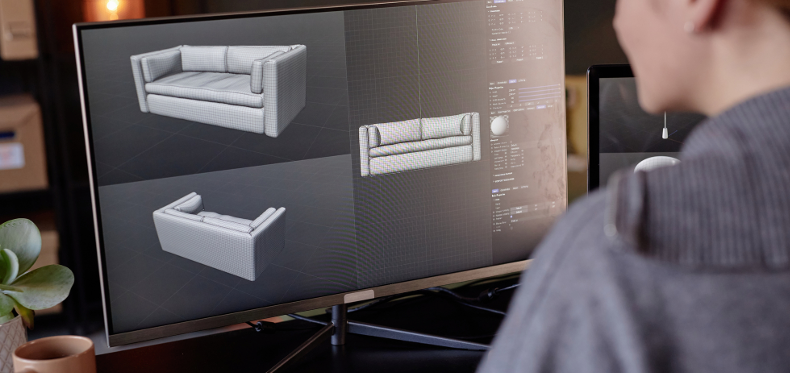
The Sofa Back Problem is the clearest illustration of why: Ask a leading generative model to render the rear 45-degree view of a sofa it has only seen from the front and it will not refuse. It will invent the geometry it has not been shown. A wooden frame may appear where the brand has none. The upholstery may extend in ways that contradict the manufacturing pattern. The model is doing exactly what it was built to do: produce a mathematically pleasing image, regardless of whether that image matches reality.
-
The fix is architectural, not creative: AI can generate the room. It cannot generate the product. The product must come from a verified 3D asset library that already encodes the geometry, dimensions, materials, and configuration rules of what the brand actually manufactures. Grounded in that foundation, AI visual generation is transformative. Without it, the shortcut is expensive in ways that take eighteen months to fully show up.
The temptation and the problem
A creative director opens Midjourney, types "modern modular sofa in sage green, Nordic interior, natural light," and watches a stunning image resolve on screen in roughly thirty seconds. The composition is gorgeous. The lighting feels like an editorial shoot from Copenhagen. The fabric reads as soft and lived-in, the room is impossibly tasteful, and for a moment the entire economics of furniture marketing seems to shift in their favour.
Then they try to sell it, and the wheels come off.
The sofa in the image is not the sofa the brand actually manufactures. The proportions are subtly off. The cushion architecture follows no pattern the upholstery team has ever specified. The visible stitching is inconsistent with the brand's standards. The fabric texture comes from somewhere in the model's training data rather than the actual mill the brand buys from. As Cylindo's Structured Data ebook puts it: a visual that is merely close enough is more than a marketing failure. It is a conversion killer and a direct threat to brand equity.
The market for AI visual tools is splitting rapidly into two categories that look superficially similar but operate on fundamentally different assumptions:
-
Aesthetic AI tools generate plausible imagery from text prompts. They are perfectly suited to mood boards, ideation, and creative exploration.
-
Production-grade visual AI infrastructure integrates with verified product data and can be safely deployed across thousands of SKUs in live commerce environments.
Most vendors sit firmly in the first category. Most creative directors do not yet realise how dangerous it is to treat them as though they belonged to the second.

What generic AI generators actually do
The clearest illustration of why generic AI generators fail in product marketing is what we have started calling the Sofa Back Problem. Ask a leading generative model to render the rear 45-degree view of a sofa it has only ever seen from the front, and it will not refuse the request. It will simply invent the geometry it has not been shown.
A wooden frame might appear where the brand's actual sofa has none. A back zipper may disappear because the model has decided the design is cleaner without it. The upholstery might extend in ways that contradict the manufacturing pattern. The legs may pick up a finish the brand has never offered. The model is doing exactly what it was built to do, producing a mathematically pleasing image, and it will happily invent geometry and hallucinate structural or material details in service of that goal.
That behaviour is interesting in a creative-experimentation context and disastrous in a product-marketing context. Furniture brands sell thousands of complex, highly customisable SKUs through channels where the visual representation functions as decision-support infrastructure rather than as artistic suggestion. A shopper looking at a product detail page is making a several-thousand-dollar commitment based on what they see, and any hallucinated detail that contradicts the actual product becomes a return waiting to happen.
The legal dimension of this problem deserves more attention than it typically receives in creative circles. Product imagery that misrepresents dimensions, materials, or structural details is not just a customer-service issue. It creates direct exposure under consumer protection rules and advertising standards in most major markets, particularly when used in performance media where the visual is doing real persuasive work at the moment of purchase. A brand using generic AI generators to populate its catalog at scale is not merely cutting corners on photography. It is silently accumulating a compliance and brand-equity risk that does not show up on any dashboard until it does.

What grounded AI generation looks like
The good news is that the underlying capability of generative AI is genuinely transformative once it is paired with a foundation that prevents the hallucination problem. The Six Trends Report 2026 frames it clearly: Cylindo Quickshot creates lifestyle imagery at scale using SKU-correct product visuals in real settings. The operative phrase is SKU-correct, not statistically plausible. The AI generates the room, the styling, the lighting, and the environmental context, but the product sitting inside that scene comes from a verified 3D asset rather than from the model's imagination.
The Difference in Practice: MAKE Nordic
SKU-Correct Lifestyle Imagery at Scale. Faster Campaigns. No Additional Content Cost.
MAKE Nordic uses Cylindo Quickshot to generate lifestyle imagery across its modular furniture range. The brand's 3D assets encode the exact geometry, fabric specifications, and configuration rules of every product in the catalog, which means every generated image is accurate to the product regardless of the room environment the AI creates around it. Faster content production enables quicker campaign cycles without introducing the visual accuracy risk that generic generators carry.
Read the full case study here.
"Quickshot makes it straightforward to create lifestyle imagery that supports our goals. Faster visuals mean quicker campaigns, and the ability to scale content without extra cost helps us focus on engaging shoppers and growing the business."
— MAKE Nordic, via the Cylindo Structured Data ebook
Visual governance as brand infrastructure
The deeper strategic point is that AI visual generation is no longer a creative tool to be evaluated in isolation. It is a piece of brand infrastructure that demands the same governance any other revenue-touching system in the business would receive.
AI alone generates images. Structured data is what generates images consumers can actually trust. The difference between those two outputs is the difference between a content engine that compounds brand equity and a content firehose that quietly erodes it.
The commercial case for getting the governance question right is reinforced by the cost side of the equation. Across the Cylindo customer base, the grounded approach to visual generation reduces visualization costs by an average of 58%, according to the Cylindo Nordic and US Retailers Reports 2026. The safe path is also the cheaper path at scale, which is unusual for a category where governance investments typically trade off against cost efficiency rather than improve it.
The safe path to AI visual scale
The fastest-moving brands have already drawn the line between AI-generated content and structured product representation, and they are pulling ahead of competitors who treat generic image generators as a viable replacement for proper visual infrastructure.
The synthesis is straightforward to state and harder to commit to in practice:
-
Use AI for the room
-
Use 3D for the product
-
Treat the combination as the new default for modern visual commerce
The combination is transformative when the foundation is right. The shortcut of skipping the 3D layer is expensive in ways that take eighteen months to fully show up. The gap between what generic generators promise and what grounded generation delivers becomes obvious within a single side-by-side comparison, and the brands that have seen that comparison are not going back.

Frequently Asked Questions
Why do AI image generators like Midjourney produce inaccurate furniture imagery?
Because they are trained on internet imagery rather than your specific products. They generate statistically plausible furniture, but proportions are invented, material textures come from training data rather than your actual fabrics, and structural details may be physically impossible to manufacture. The Sofa Back Problem is the clearest example: asking a generic AI to render a sofa from a rear 45-degree angle will reliably produce hallucinated geometry the model has never actually seen.
What is the commercial risk of using AI-generated product imagery without 3D grounding?
Customers who purchase based on imagery that misrepresents the product's appearance, dimensions, or materials will return it, and they will tell other customers about the experience. A visual that is merely close enough is a conversion killer and a direct threat to brand equity. Beyond the return costs, there is meaningful exposure under advertising standards and consumer protection rules in most major markets.
How does Cylindo Quickshot differ from generic AI image generation?
Cylindo Quickshot uses the brand's verified 3D product model as the product truth layer underneath every generated image. The AI generates the room environment, the styling, and the lighting, while the product sitting inside the scene is the exact product the brand sells: geometrically accurate, correctly dimensioned, and in the brand's actual fabrics and finishes. The Six Trends Report 2026 describes this as lifestyle imagery at scale, using SKU-correct product visuals in real settings.
What is visual governance and why does it matter for AI-generated content?
Visual governance is the system of standards and infrastructure that ensures every visual representation of a product is accurate, consistent, and brand-compliant. As AI visual generation scales, brands with visual governance infrastructure in place (including verified 3D assets and controlled generation pipelines) will maintain brand integrity. Brands without that infrastructure will generate plausible but inaccurate product representations at scale, compounding brand-equity and compliance risk with every image produced.
Can AI-generated furniture imagery ever be used safely in marketing?
Yes, when it is grounded in accurate 3D product data. Across the Cylindo customer base, the grounded approach reduces visualization costs by an average of 58%, according to the Cylindo Nordic and US Retailers Reports 2026. The safe path to AI visual scale is also the cheaper path to it, which makes the infrastructure investment straightforward to justify at boardroom level.