TL;DR: Global e-commerce is forecast to exceed $6.4 trillion in 2025 — and furniture is one of the fastest-moving categories within it. The brands winning online aren't simply selling through a digital channel. They're building visual infrastructure that closes the experiential gap, feeds AI discovery systems, and scales across every touchpoint without a photoshoot. The brands that haven't made that shift yet are running out of time to start.
Key points:
-
The economic centre of gravity has moved — permanently: With global e-commerce forecast to exceed $6.4 trillion in 2025 and account for over 20% of all retail sales worldwide, online is no longer a channel. It is the default. Physical retail survives as a complement, not a competitor.
-
Three forces are driving dominance — and furniture brands must respond to all three: Convenience (endless aisle, frictionless checkout, 24/7 access), immersive technology (3D, AR, AI personalization that closes the tactile gap), and data-driven efficiency (product analytics, demand forecasting, omnichannel asset distribution).
-
AI is the new frontier — and it changes the rules: AI shopping agents are beginning to intercept the furniture purchase journey before a human visits a product page. Brands optimised only for human browsing will be invisible to the autonomous shoppers now entering the funnel.
The shift is not coming. It already happened.
Global e-commerce sales are forecast to exceed $6.4 trillion in 2025, accounting for more than 20.5% of all retail sales worldwide. That is not a trend line pointing toward a future inflection point. That is the current state of retail.
Physical retail has not disappeared — and it won't. Showrooms, experiential flagships, and local boutiques still play a real role in the furniture buying journey. But the economic centre of gravity has permanently shifted. Inventory management, transaction volume, and commercial value are concentrating online at a rate that physical retail cannot match.
For furniture brands, this shift carries specific implications that go beyond adding a checkout button to a website. The macro context makes it urgent: April 2025 furniture orders were down 9% year-on-year according to Smith Leonard's Furniture Insights report, and the global furniture market is forecast to grow at a CAGR of just 2.4% through to 2035. Flat in inflation-adjusted terms. In that environment, volume-driven growth is no longer a strategy — efficiency and conversion rate per visit are the only levers that move the needle.
Furniture is a high-consideration, high-regret category where the gap between online browsing and confident purchasing has historically been wide. The brands closing that gap are pulling ahead. The ones still treating online as a secondary channel are losing ground to competitors who don't.
Force 1: Convenience — the endless aisle and the frictionless funnel
Convenience is the structural advantage that e-commerce holds over physical retail and will never relinquish. 24/7 access, no travel, no queues, instant price comparison across dozens of brands — these are table stakes now, not differentiators.
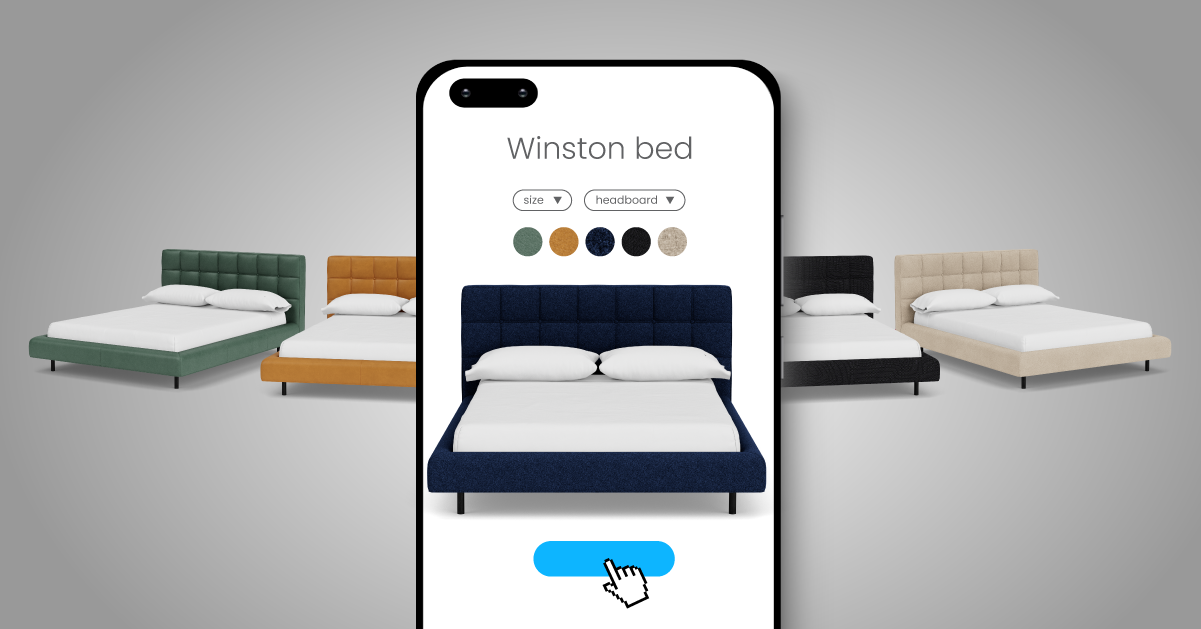
For furniture specifically, the endless aisle is the most commercially significant convenience benefit. A physical showroom can display hundreds of products. An online store powered by visual commerce can present every SKU in every configuration — without manufacturing or warehousing a single additional unit. Life Outdoor Living deployed Cylindo's visual commerce solution across their full modular outdoor range. Within a year, online revenue rose 75% and e-commerce's share of total revenue nearly doubled — from 3.7% to 6.8%.
Frictionless checkout amplifies the convenience advantage further. One-click ordering, saved payment methods, and BNPL options have compressed the final conversion moment to near zero. Every second removed from the buying journey improves conversion — and the retailers investing in both ends of the experience (discovery through visualization, checkout through frictionless payment) are compounding those gains.
Force 2: Immersive technology — closing the tactile gap
The biggest historical barrier to furniture e-commerce was simple: customers couldn't touch the sofa, feel the fabric, or see how a piece looked in their space. That argument is no longer as strong as it was — because the technology that replaces those experiences has matured to a point where it directly drives conversion.
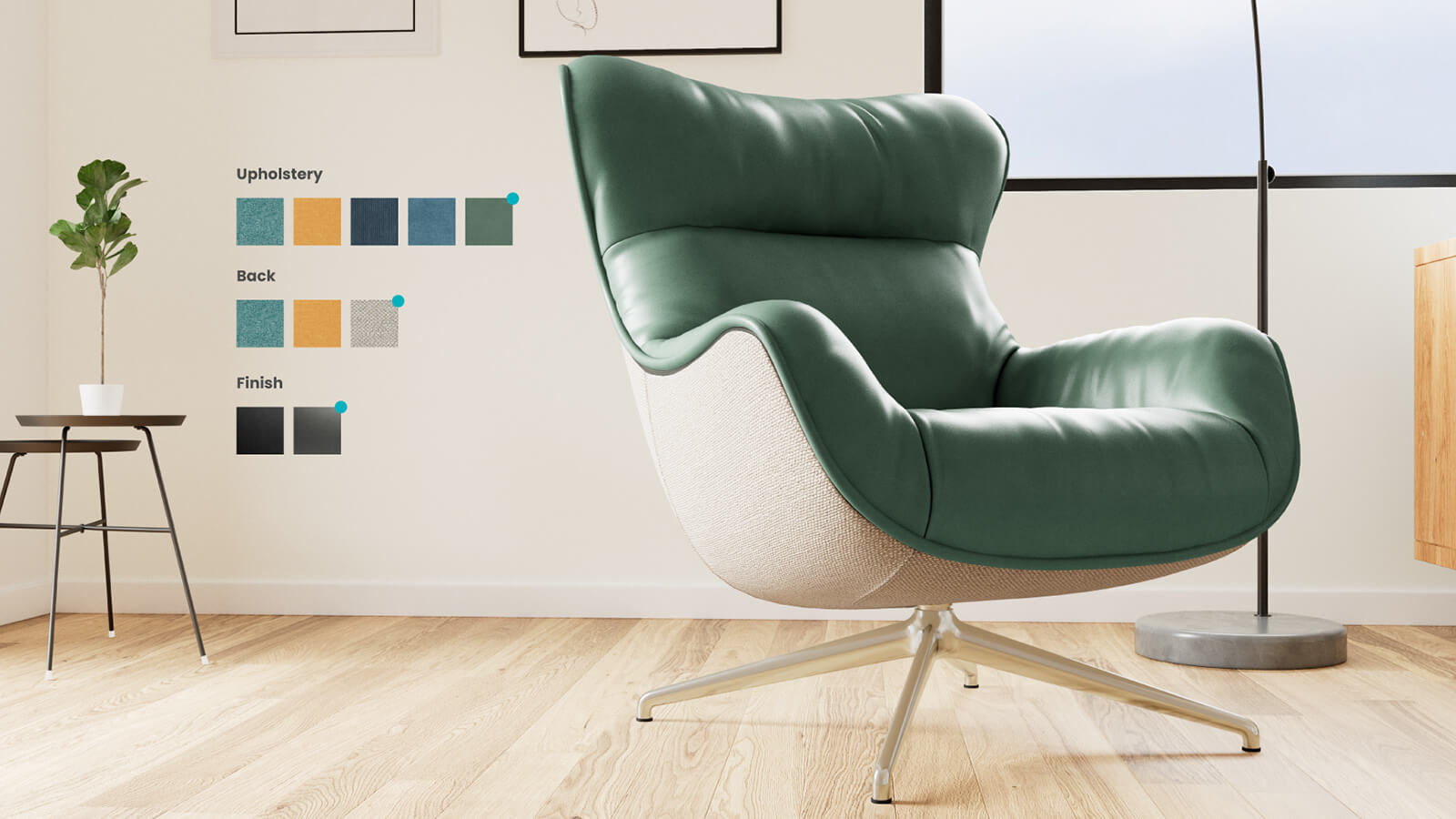
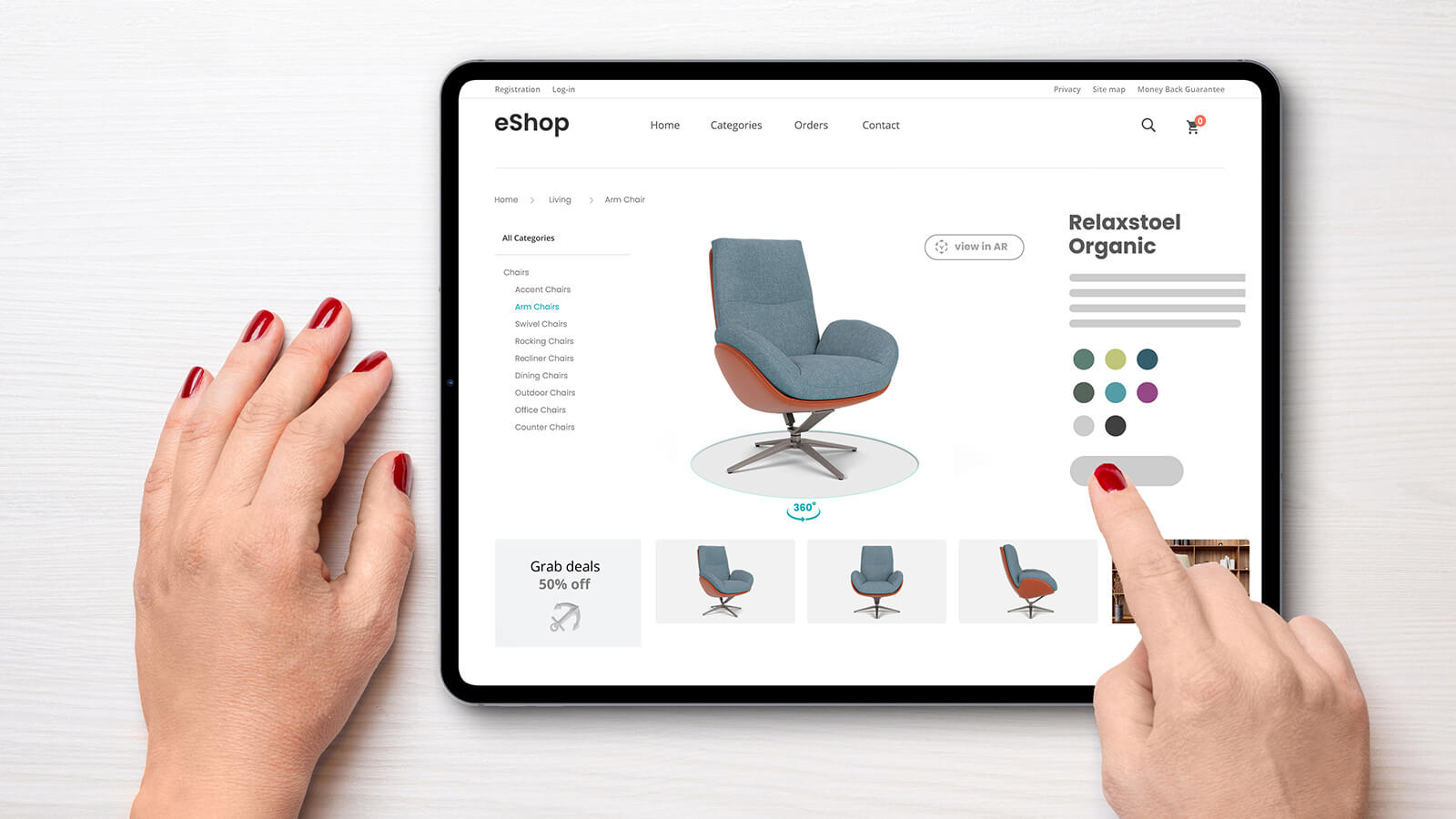
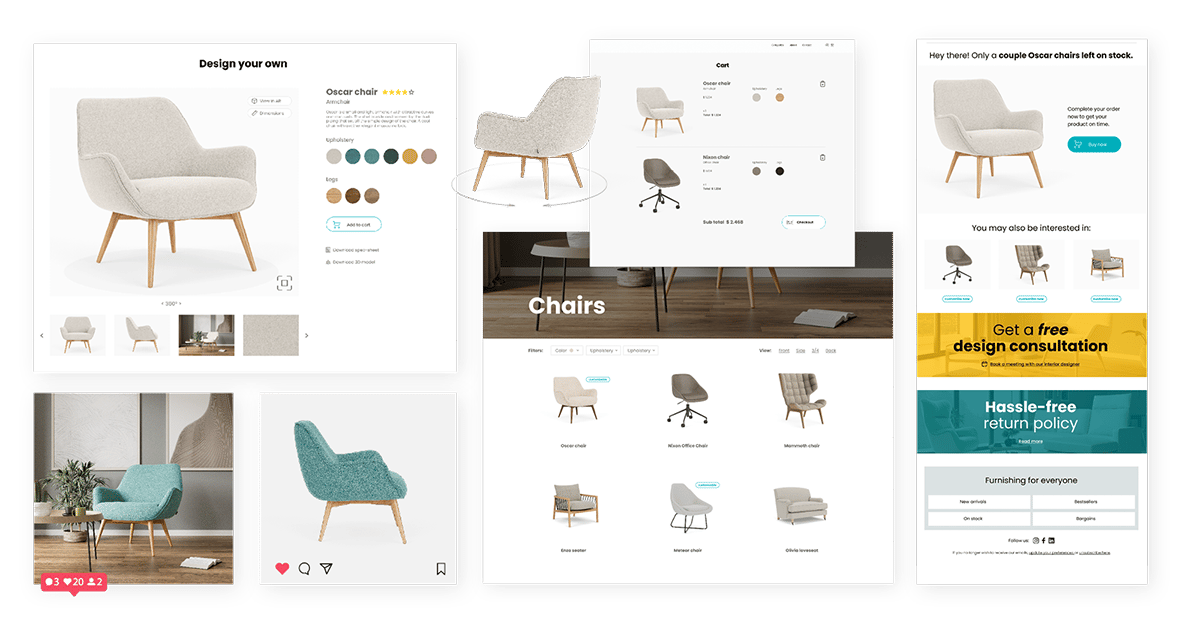
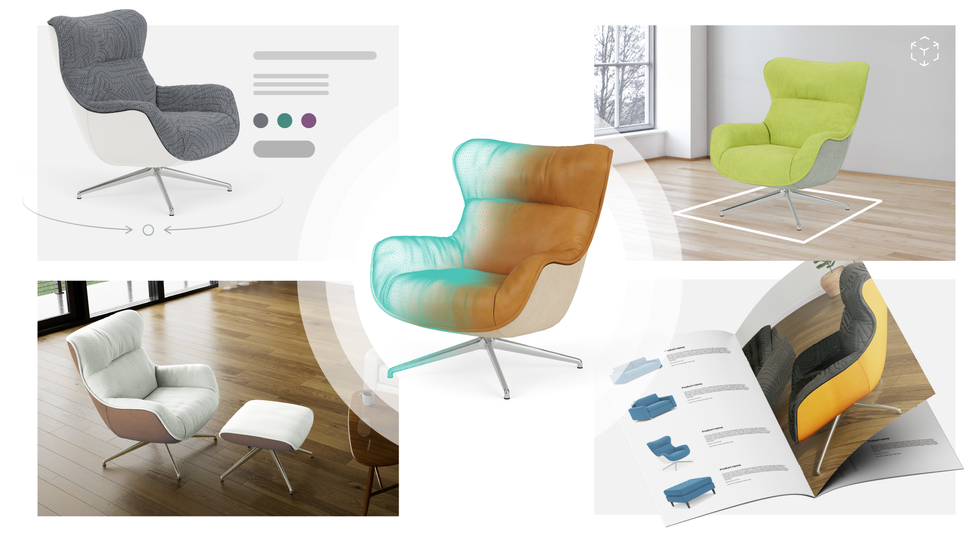
360-degree interactive viewers, real-time product configurators, photorealistic lifestyle imagery, and web-native AR have collectively closed the experiential gap that kept furniture purchases in the showroom. EQ3, Canada's leading furniture designer and retailer, deployed Cylindo's 360 HD Viewer and AR across 450+ products. The outcome: a 36% increase in conversions, an 88% increase in AOV, and a 116% increase in page views. They also identified a halo effect — customers who engaged with the 360 viewer were more likely to convert on products that weren't even visualized with it, because the overall brand credibility improved.
Proof of Impact: EQ3
+36% Conversions. +88% AOV. +116% Page Views.
After deploying the Cylindo 360 HD Viewer and AR across 450+ products, EQ3 saw measurable lifts across every key performance metric — plus a halo effect where engagement with the viewer improved conversion rates on non-visualized products across the site.
Read the full case study here.
AR takes the experiential gap further. Interior Define found that customers using AR were 8x more likely to convert than those who didn't — and that web-native AR adoption ran 33x higher than their previous app-based solution. The barrier was not the technology. It was the friction of downloading an app. Remove the friction and the technology does what it promises.
AI-powered personalization adds a further layer. Recommendation engines and predictive analytics now identify what a shopper is likely to want based on their browsing behaviour — surfacing relevant products, complementary items, and appropriate lifestyle content without requiring manual curation. Every click refines the data, and every subsequent visit reflects a store experience shaped by the previous one.
Force 3: Data-driven efficiency — the operational advantage that compounds
E-commerce wins on economics as well as experience. Physical retail carries fixed overhead — rent, staffing, inventory space, utilities — that limits operational flexibility regardless of demand. Online operations scale without replicating infrastructure in every location.
The deeper advantage, though, is data. Every online interaction — a 360-spin, a configuration change, an AR activation, an abandoned cart — creates a signal about customer intent that physical retail cannot capture with the same granularity. Furniture brands using product visualization analytics can track which configurations drive conversion, which products generate the most engagement, and which touchpoints in the journey are losing customers — and act on that data in near real time.
Polly Products demonstrated this directly. Before deploying Cylindo's 3D platform, average time on site was 34 seconds, organic traffic was seasonally declining, and the annual marketing budget was capped at $130K — because there was no performance data compelling enough to justify expanding it. After replacing static photography with photorealistic 3D, time on site grew to 1 minute 48 seconds, organic traffic increased 17%, and leadership expanded the marketing budget to $409K — a 215% increase — because the data now existed to prove the investment was working.
The operational efficiency case extends to content production. Riverside Furniture saves $100,000 annually by replacing regional photoshoot workflows with Cylindo Studio — generating lifestyle imagery for every market from a single 3D asset set, in hours rather than weeks. Life Outdoor Living's results go beyond revenue: their e-commerce share of total business grew 83% year-on-year after deploying Cylindo, as the platform gave their two-person team the visual coverage to compete with retailers ten times their size.
Buyers needed the confidence that our premium price matched premium quality. Cylindo's visuals remove that element of doubt."
— Giel van Balen, E-commerce Manager, Life Outdoor Living
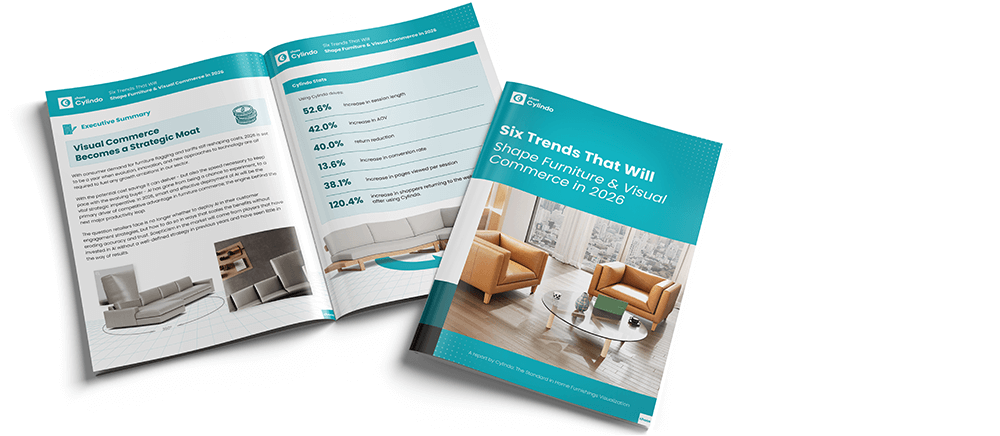
Across Cylindo's customer base, the platform drives a 52.6% increase in session length, a 38.1% increase in pages viewed per session, and a 120.4% increase in returning shoppers. These are not conversion rate metrics — they are engagement and loyalty metrics that compound. Customers who interact with high-fidelity 3D don't just buy once. They come back.
The 2026 frontier: AI as the new e-commerce layer
The three forces above — convenience, technology, and efficiency — have defined the e-commerce revolution to date. In 2026, a fourth is emerging that changes the rules more fundamentally than any of the previous three.
Autonomous AI shopping agents are beginning to intercept the furniture purchase journey before a human visits a product page. These systems query structured product data, evaluate against user requirements, and in some cases execute purchase decisions on behalf of the user. The brands optimised only for human browsing will be invisible to these systems.
AI can imagine the room. It cannot imagine the product. The brands that give AI accurate, structured product data to work with will be recommended. The ones that don't will not be found.
What makes a furniture product AI-recommendable is not lifestyle photography or marketing copy. It is structured product data — accurate dimensions, material specifications, configuration options expressed as machine-readable metadata, and high-fidelity 3D models that can be evaluated against spatial requirements. This is not a future consideration. It is the infrastructure decision that furniture brands need to make now, before AI commerce scales past the point where catching up is commercially viable.
MAKE Nordic — architect-designed sustainable furniture sold primarily online — built their digital experience around exactly this kind of structured product infrastructure. After deploying Cylindo's visualization platform, customisation adoption shifted from 10% to 50% of all orders — a 5x increase — because customers could finally see what they were buying clearly enough to configure it confidently. That same structured data now makes their products evaluable by AI systems in a way that static photography never could.
Proof of Impact: MAKE Nordic
10% → 50% Customisation Adoption. 5x Increase. YoY Revenue Growth.
After deploying Cylindo's visualization platform, MAKE Nordic shifted from 90% of customers choosing standard pre-configured products to a 50/50 split between standard and customised orders. The 5x increase in customisation adoption contributed directly to year-on-year revenue growth — driven by customers who could now see and trust what they were configuring.
Read the full case study here.
What omnichannel actually means in 2026
Physical retail is evolving, not disappearing. Showrooms, experience centres, and click-and-collect models all have a legitimate role in the furniture buying journey — but that role is now defined in relation to the digital channel, not independently of it.
FEST Amsterdam equips store associates with tablets running Cylindo during in-store design consultations — the same visuals, the same configurations, the same experience customers had at home. MAKE Nordic's showrooms function as quality validation points for purchases that begin and end online. Sofacompany uses the Cylindo 360 HD Viewer in-store for their Design Your Own programme — the digital tool serves the physical experience, not the other way around.
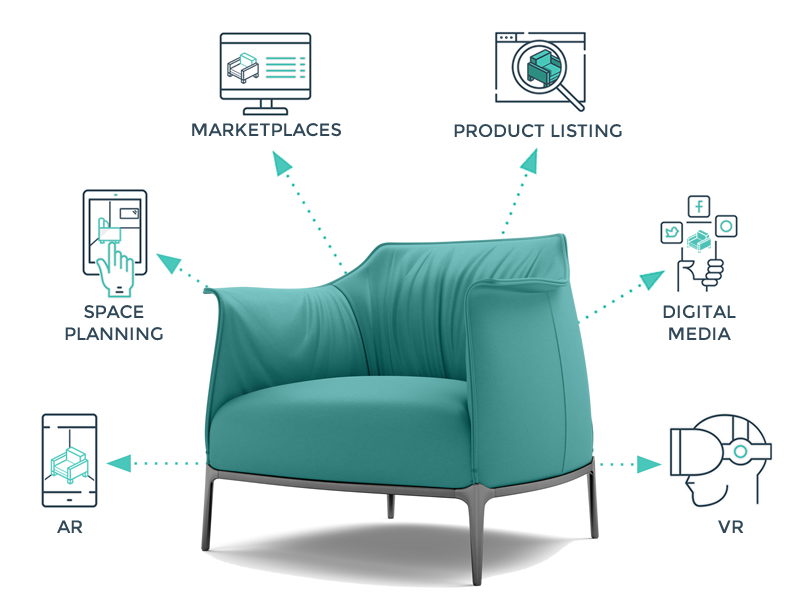
For furniture brands, omnichannel is not a distribution strategy. It is a visual consistency requirement. When customers move between a brand's website, its showroom floor, its marketplace listings, and its retargeting ads — and see inconsistent visuals — they make a judgement about the brand's credibility, not about a channel. The brands that have built a single 3D asset library feeding every touchpoint from one verified source have solved this. The ones managing separate photography workflows for separate channels have not.
The e-commerce revolution did not happen to furniture brands. It happened around them — and the ones that moved early built a compounding advantage that is now structurally difficult to close. The ones moving now are not catching up with where the market was. They are building the infrastructure for where it is going: AI-discoverable, omnichannel-consistent, and data-driven at every stage of the journey. Read how leading brands are approaching visual merchandising across every channel for a practical framework on how the asset infrastructure fits together.
Frequently Asked Questions
Why is furniture e-commerce growing faster than other retail categories?
Furniture e-commerce is growing faster than the category average because immersive visualization technology — 3D viewers, AR, real-time configuration — has closed the experiential gap that historically kept furniture purchases in physical stores. When customers can see a piece at every angle, in every configuration, and place it in their own room via AR before buying, the primary barrier to online purchase is removed. EQ3 saw a 36% conversion increase and 88% AOV lift after deploying photorealistic 3D and AR — that level of performance lift is what is driving category acceleration.
What does the e-commerce revolution mean specifically for furniture brands?
It means that the competitive differentiation that used to come from showroom location and sales staff quality has shifted to digital experience quality. The furniture brands winning online in 2026 are the ones with comprehensive 3D visual coverage, real-time configuration, AR capability, and structured product data that feeds AI discovery systems. The ones still relying on static photography and flat product feeds are losing specifications, conversions, and market share to brands that have made the infrastructure investment.
How is AI changing furniture e-commerce in 2026?
AI is introducing a new layer of the purchase funnel that operates before a human visits a product page. Autonomous AI shopping agents query structured product data, evaluate against user requirements, and can execute or recommend purchases on behalf of users. For furniture brands, this means that structured product data — accurate dimensions, material metadata, configuration options — is now a commercial requirement, not a technical detail. Brands without machine-readable product infrastructure will be invisible to AI discovery systems regardless of how strong their human-facing website experience is.
Is physical retail dead for furniture brands?
No — but its role has fundamentally changed. Physical showrooms now function primarily as trust-validation environments for purchases that begin and often end online, as experience centres that complement the digital channel rather than compete with it, and as logistics hubs for click-and-collect fulfilment. MAKE Nordic's showrooms are specifically designed to support their webshop — customers visit to experience quality in person, then return home to configure and purchase online. Sofacompany uses their in-store environment to drive online engagement. The successful furniture retail model in 2026 is digital-led with physical support, not the reverse.
What visual infrastructure do furniture brands need to compete in e-commerce in 2026?
At minimum: photorealistic 3D visualization across the full product range, real-time configuration covering all fabric, finish, and size options, web-native AR, accurate dimension shots, lifestyle imagery scalable across channels, and a single 3D asset library feeding every touchpoint consistently. Beyond the minimum: structured product metadata that is machine-readable by AI systems, programmatic asset distribution to marketplaces and B2B portals, and product analytics that track visualization engagement and connect it to commercial outcomes.