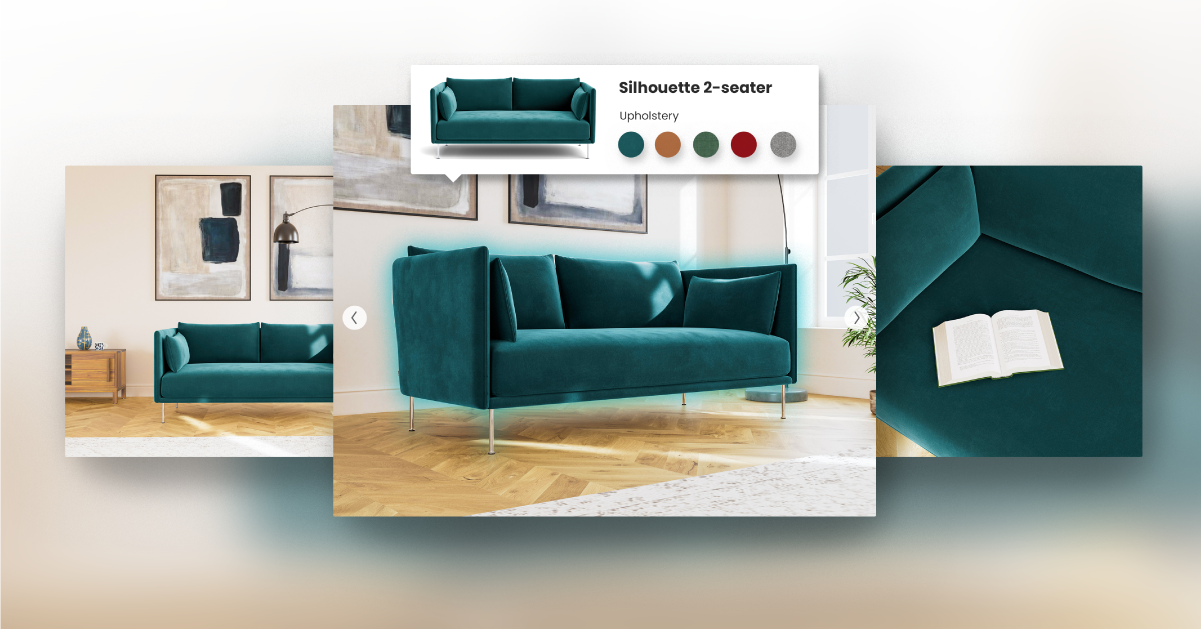

TL;DR: Legacy 3D visualizers create massive technical debt by bloating page speeds and breaking CI/CD pipelines. By adopting a headless, API-first architecture, you can connect visual configuration directly to your PIM and ERP, ensuring real-time catalog accuracy without slowing down your storefront.
Key points:
-
Decoupled Architecture: Move heavy visual computing to dedicated cloud infrastructure. This keeps your frontend fast and your backend clean.
-
Single Source of Truth: Connect 3D assets directly to your PIM and ERP. Product rules and logic sync automatically without manual IT tickets.
-
API-First Integration: Plug seamlessly into Shopify, Salesforce, or custom composable stacks without building fragile, proprietary middleware.
The Death of the "Franken-Stack"
Say the phrase "new 3D visualizer" in a room full of CTOs and IT leaders, and you can watch the temperature drop. The phrase is loaded with bad memories.
Bloated JavaScript bundles tanked page speed. Proprietary plugins fought every CI/CD pipeline. Frontend integrations broke every time the vendor pushed an update, and ERP sync jobs silently failed at three in the morning.
The visual layer of e-commerce has historically been one of the biggest sources of technical debt in any retail stack. The scars run deep.
That history is not the present, and it is definitely not the future. The era of monolithic, hard-coded visual plugins is over.
Modern e-commerce architecture demands a decoupled approach. Heavy visual computing is handled off-site, in dedicated cloud infrastructure, and delivered to the storefront as lightweight, optimized payloads.
The frontend stays fast. The backend stays clean. The visual layer stops being a burden and starts being a service.
A headless 3D product visualization platform is not just another integration on the list. It is a fundamental architectural upgrade. By connecting directly to your PIM, ERP, and storefront through well-designed APIs, you break down the silos between product data and visual assets.

Bridging the Gap Between PIM and Pixel
The deepest problem in legacy 3D setups is a data problem, not a graphics problem. Traditional implementations treat 3D models as static frontend assets.
They get exported by the creative team, dropped into a CDN, and wired into the storefront. The configuration rules are essentially hardcoded in the visualizer itself.
The product data lives in the PIM and ERP. The visual data lives somewhere else entirely. The two systems have no idea about each other.
The cost of that disconnection shows up the first time a real product rule changes. A fabric gets discontinued. A leg finish goes out of stock. A specific frame cannot be paired with a certain cushion depth due to manufacturing constraints.
In a legacy setup, every one of those changes turns into an IT ticket. Someone has to find the visualizer's config file, update it manually, retest the affected SKUs, and redeploy.
Until that work is finished, the storefront shows configurations the factory cannot actually build. True API-first architecture means the data flows bi-directionally.
When configuration rules live where they belong—in your PIM and ERP—your 3D visual asset management system and CMS reads those rules dynamically rather than maintaining its own private copy.
If the ERP says the navy bouclé is discontinued, the configurator stops offering it. If the PIM adds a new fabric, the configurator picks it up on the next request. No tickets. No redeploys. No data drift.
The Headless Imperative
A common objection still circulates in technical leadership conversations: "Adding a massive 3D configurator is going to destroy our Shopify or Salesforce page load speeds. Our Core Web Vitals will fall off a cliff, and we will pay for it in SEO."
The concern is completely reasonable for the old generation of visualizers. In legacy builds, the entire 3D engine was forced to live inside the customer's browser.
Megabytes of textures had to be downloaded before the first frame rendered. CPU and GPU usage spiked on mid-range mobile devices, and Lighthouse scores collapsed. Those visualizers earned their bad reputation.
Headless 3D rendering operates on a fundamentally different model. The computational heavy lifting happens on cloud servers purpose-built for the job.

"We opted for Cylindo over other vendors due to its remarkable fast loading speed, exceptional quality of renders, and agility in keeping up with our fast-paced projects. These features were critical in enhancing our online customer experience."
— Félix Robitaille, Director of Marketing, Cozey
The frontend receives lightweight, pre-optimized data payloads precisely when they are needed. By optimizing viewer load speed, Core Web Vitals stay healthy and page loads stay fast.
Cylindo's headless APIs are designed to plug directly into whatever storefront you run, whether that is Shopify, Salesforce Commerce Cloud, BigCommerce, Adobe Commerce, or a custom build.
The Plug-and-Play Architecture
The other classic failure mode of older visualization deployments is the middleware problem.
A development team gets handed a proprietary 3D engine that does not speak the same language as the legacy ERP. Months of work get poured into custom adapters, glue code, and translation layers.
The middleware becomes its own source of fragility, slowing down the roadmap and increasing the surface area for outages. The team essentially builds a parallel system that requires constant babysitting.
The modern alternative is API-first, composable commerce. A visualization platform built on clean REST APIs can be embedded anywhere with minimal code.
Web. Native mobile apps. In-store kiosks. B2B trade portals. Wherever you need 3D, the same APIs serve it, and the same product logic flows through. The middleware problem evaporates.
Proof of Impact: Interior Define
Scaling Omnichannel Visuals via API
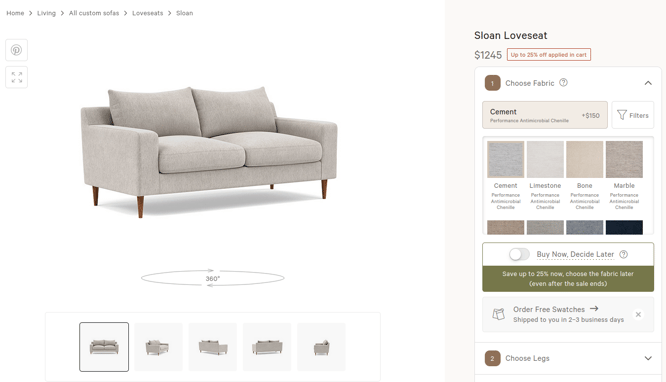
Real-world proof: See how Interior Define used API-first 3D visualization to create a consistent, customized shopping experience across channels. Read the case study here.
Picture the day-to-day reality this enables. Your merchandising team adds a new modular sofa line to the PIM on a Tuesday morning. They define the frame options, the upholstery library, and the configuration rules.
Because of the integrated tech stack, Cylindo's API instantly reads the new product logic. It generates the visual permutations on demand and pushes a live 3D modular furniture configurator to your Shopify product page.
The merchandising team checks the storefront a few minutes later, sees the configurator working perfectly, and moves on. Zero developer intervention required.
Future-Proofing the Tech Stack
The underlying principle is simple: Visual commerce should enhance your architecture, not complicate it.
Every capability you add to the customer experience should leave the underlying stack more flexible, more maintainable, and more performant. A 3D platform that drags down page speed and requires custom middleware is a step backward.
A headless, API-driven 3D visualization platform, like Cylindo, slots cleanly into a modern composable stack. It plays well with everything around it and removes work from the IT team's plate.
That distinction matters because the next five years of e-commerce will keep raising the bar on visual richness. AR, generative AI experiences, and personalized configurations all require a strong 3D foundation.
Picking the right API-led architecture now makes the next set of upgrades cheap and fast to ship. Stop hardcoding visual experiences. Let your data drive your 3D assets, and let your storefront stay focused on selling.

Frequently Asked Questions
Why do legacy 3D visualizers slow down e-commerce websites?
Older visualizers force the customer's browser to do the heavy rendering work, downloading megabytes of raw geometry and texture files before displaying a product. This spikes CPU usage, blocks the main thread, and ruins Core Web Vitals and SEO performance.
How does an API-first 3D configurator work with a PIM or ERP?
An API-first configurator doesn't hardcode product rules. Instead, it dynamically reads configuration logic (like discontinued fabrics or restricted modular setups) directly from your PIM or ERP. This ensures your 3D visuals always match your actual inventory and manufacturing capabilities without requiring manual IT updates.
What is headless 3D rendering?
Headless 3D rendering separates the visual backend from your storefront. The complex computation and rendering happen on dedicated cloud servers, and your Shopify or Salesforce site simply receives a lightweight, pre-optimized image payload, keeping your page load speeds fast.