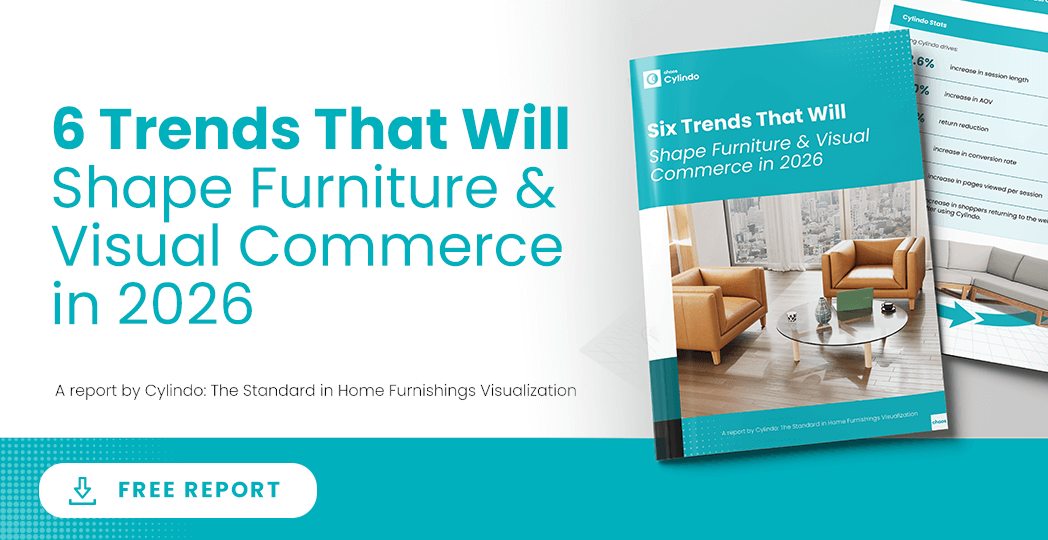
TL;DR: Furniture demand is soft and tariffs keep pricing unsettled in the US and Europe, so discounting alone won't move buyers in the years ahead. Cylindo's Six Trends report finds the brands gaining share are investing in visual trust: rich product visualization, AI content built on accurate product data, consistent visuals across every channel, and clear reporting on what that content returns. Cylindo AI Master Assets now make that standard affordable across the whole catalog.
Key points:
-
Demand is uneven and pricing is unpredictable: soft orders in the US and Europe, and tariffs on upholstered goods, vanities and cabinetry, mean retailers cannot rely on volume or discounting.
-
Visual experience now sits alongside price as a conversion lever: retailers using Cylindo's full visualization suite convert 35% or more than those relying on static images.
-
AI content has to be accurate as well as fast: Cylindo AI Master Assets generate imagery from a 3D asset built from the real product, with no content creation fee for eligible products.
-
Consistency across channels builds trust: furniture buyers research for weeks across devices and stores, so one verified asset should power every visual they see.
-
Visual content ROI is now a boardroom topic: Life Outdoor Living saw an 83% year-on-year increase in ecommerce share and 44% higher AOV, while saving EUR 130,000 to 150,000 a year.
Visual commerce will decide furniture retail in the years ahead because, with demand soft and prices under pressure, buyer trust has become the deciding factor, and trust in a big-ticket purchase comes from seeing exactly what you're buying. That's the central finding of Cylindo's report, Six Trends That Will Shape Furniture and Visual Commerce.
What is the visual economy?
The visual economy is a retail environment where product visuals, not text or price, drive how shoppers discover, evaluate and buy. Brands compete on how well they show their products, using a visual commerce platform to deliver photorealistic, interactive and consistent visuals online and in-store.
Furniture is where this matters most. Buying a sofa is nothing like buying batteries: it involves personal style, emotional investment and the question of whether a piece will fit an existing room. Shoppers want to see how it looks in a space, picture how it feels and judge how it will sit alongside what they already own.
How IKEA proved the case for CGI
IKEA was one of the pioneers. It quietly moved from traditional product photography to CGI in 2006, and within eight years around 75% of its catalog imagery was rendered rather than photographed. Most customers never noticed. Great visualization works because it removes friction, builds trust and helps customers connect with what they are buying before they add it to their cart.
Why discounting won't fix soft furniture demand
The furniture market isn't collapsing, but it's hard to read. Demand has been soft on both sides of the Atlantic, with high interest rates and cautious consumers holding back big-ticket purchases. Germany, Europe's largest furniture market, has seen several years of falling furniture revenue, and UK shoppers have kept delaying household goods purchases. For current market figures, see our analysis of the state of the furniture industry.
Tariffs add to the uncertainty. US tariffs on upholstered goods, vanities and cabinetry have unsettled pricing for import-heavy retailers, and even IKEA has moved toward US-based production as a hedge against tariff swings. Our guide to furniture industry tariffs covers the impact in more detail.
A market like this doesn't reward blunt discounting. Every digital interaction has to earn its place, and buyer trust decides who converts.
Why trust decides furniture purchases
The furniture buyer journey is long, non-linear and emotional. Three truths shape how people shop for furniture today:
1. Shoppers start with inspiration, not specifications
Many shoppers begin without a clear idea of what they want. They browse styles, colors and room aesthetics to picture what is possible before narrowing down, which makes high-quality lifestyle imagery critical in the discovery phase.
2. The decision is long and spread across channels
Furniture is rarely an impulse buy. Customers take weeks or months to decide, revisiting products on their phone, their laptop and in-store. Inconsistent visuals between platforms erode trust and stall the decision.
3. The purchase is emotional and anxiety-prone
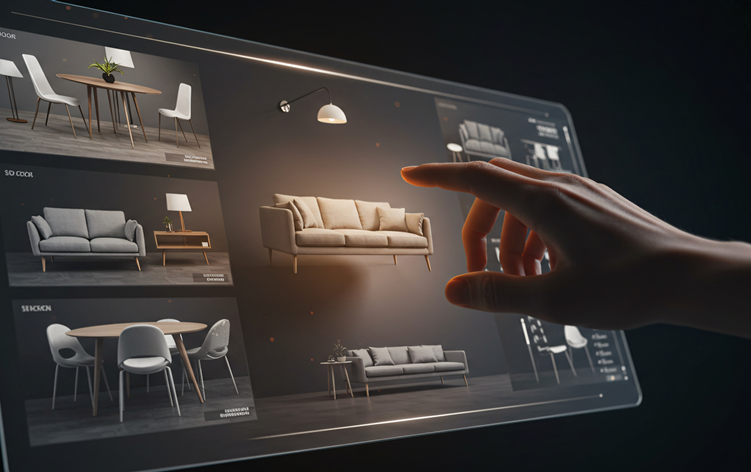
A sofa or dining table is a significant purchase, and shoppers fear choosing wrong. Visuals that show scale, material detail and real-life context, from 360-degree views to AR placement and configurable 3D, replace that doubt with confidence.
How visual experience became a primary conversion lever
The report argues that photorealistic imagery, real-time configuration and in-context product experiences now rank among the biggest levers of ecommerce conversion, alongside price and promotion rather than behind them.
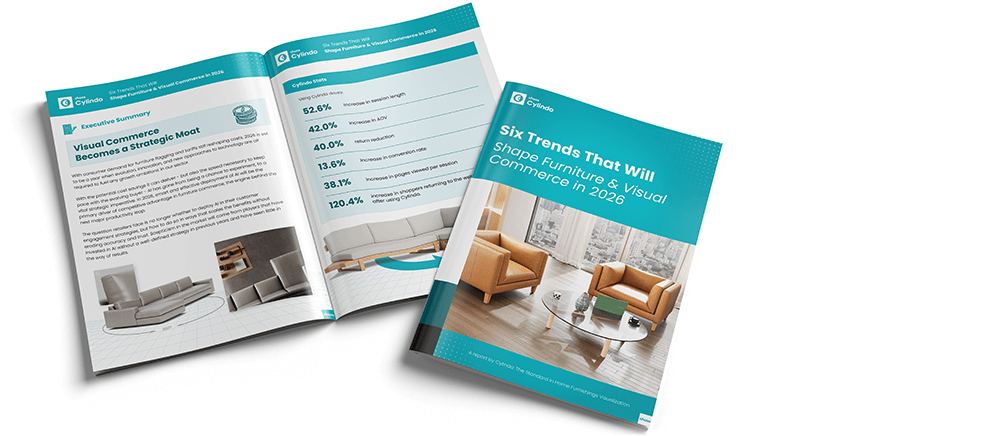
Cylindo's own data supports it. Retailers who already believed they had a strong visualization strategy, meaning more than static photography, saw an average 13.6% further increase in conversion after moving to Cylindo. Clients using the full product suite convert 35% or more than those still relying on static images. After shoppers use Cylindo-powered visualization:
-
Session length rises 52.6%
-
Average order value rises 42%
-
Shoppers returning to the site rise 120.4%
-
Returns fall 40%
The six trends at a glance
| Trend | What it means for furniture brands |
|---|---|
| Visual experience as a primary conversion lever | Photorealistic imagery and configuration now rank alongside price and promotion |
| Enterprise AI content that keeps precision | AI imagery only builds trust when it is accurate to the SKU and configuration |
| Omnichannel visual orchestration | The same verified visuals on product pages, marketplaces, social and in-store |
| Real-time visual personalization | Configurations that adapt to a shopper's style, region and budget |
| Visual commerce ROI in the boardroom | Visual content measured and reported like any other capital investment |
| AI as the main driver of competitive advantage | AI that protects margin, speeds up launches and sharpens merchandising |
Proof of Impact: Life Outdoor Living
83% YoY Increase in Ecommerce Share. 44% Higher AOV. EUR 130,000 to EUR 150,000 Saved a Year.
Life Outdoor Living replaced costly photoshoots and manual editing with Cylindo's visualization tools, building one visual asset library that scales instead of paying for shoot after shoot.
Read the full case study here.
"Buyers needed the confidence that our premium price matched premium quality. Cylindo's visuals remove that element of doubt."
Giel van Balen, E-commerce Manager, Life Outdoor Living
How AI is changing furniture visual commerce
The report is blunt about where AI content goes wrong in furniture. A photorealistic sofa image adds nothing, and damages trust, if the fabric grain, leg finish or modular layout doesn't match the real product, or if the AI invents details that don't exist. We explain why in why generic AI can't be trusted with product visuals.
That's why enterprise AI tools for furniture need to start from accurate product assets rather than generic image models. Photoshoots can cost up to $100,000 for a handful of images that start dating as soon as a range changes, so tools that produce the same output for far less, and update instantly, make obvious commercial sense. The report's warning is that tools without accuracy at the SKU and configuration level aren't enterprise-ready, however fast they are.
Cylindo AI Master Assets: accurate AI imagery for the whole catalog
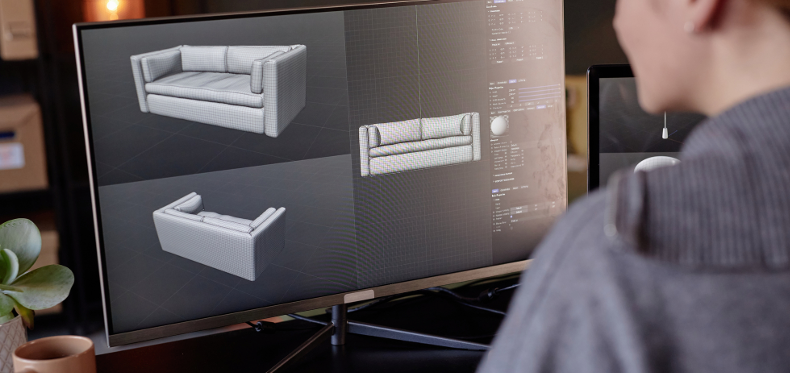
Cylindo AI Master Assets are Cylindo's AI product for exactly this problem. A team member takes four reference photos of a product, on a phone if needed. Cylindo generates a 3D asset from those photos behind the scenes, uses it to lock the camera angles, and delivers four studio-quality silo shots at 2K resolution, with up to 25 material variants. Because the imagery comes from a 3D asset built from the real product, it stays consistent across angles and variants in a way generic AI images don't.
For eligible products on a 12-month Cylindo subscription, there's no content creation fee. That makes accurate imagery affordable for the longtail products that never justified a photoshoot or full 3D production. You can test AI Master Assets on one of your own products with free silo shots.
AI Master Assets suit lower-configurability products with a single structural geometry, no patterned materials and no more than 25 material options. Output is probabilistic, so Cylindo runs several generations and you pick the best. Hero and highly configurable products still need production-grade 3D, and our guide to what AI product photography can and cannot do explains where each approach fits.
The report sees AI as the engine of the next big productivity gain in furniture retail, well beyond image generation: protecting margin, speeding up launches and sharpening merchandising. Retailers already building AI into their visual content are cutting production time while covering more SKUs with more accurate product pages.
Omnichannel: build once, use everywhere
Customers don't think in channels. They browse on their phone during a commute, check the product again on a laptop at home and talk to an associate in-store, and they expect it all to connect. When that journey breaks, trust breaks with it, and usually the sale too.
The most effective visual content for furniture includes:
-
Hero images that stop shoppers scrolling
-
Lifestyle images that show furniture in real rooms
-
Interactive 3D models and AR that bring products to life
-
Room scenes that show how pieces work together
-
Customization tools that let shoppers try colors, fabrics and layouts, and save their designs to revisit
The principle is simple: build once, use everywhere. One verified 3D asset can power the 360 viewer, AR, configurator, lifestyle imagery and dimension shots on your product pages, the visuals on marketplaces and retail partners, and the tablets your associates use in-store. For more on connecting the journey, see our guide to the ecommerce customer experience.
Why visual commerce ROI is now a boardroom question
The clearest shift in the report is who's asking about visual content spend. CFOs now treat visual investment as measurable infrastructure rather than creative spend, and boards at several major public furniture retailers have reviewed digital content cost per unit and its effect on returns and inventory aging.
Growth expectations explain why. Future Market's furniture market analysis projects global growth at a CAGR of just 2.4% through 2035, roughly flat after inflation. Add tariff and raw material volatility, and leadership attention turns to levers that protect margin rather than chase volume.
What the savings look like
The brands winning budget measure how their visuals lower acquisition costs, drive upsell and cut returns, and they report those numbers like any other capital investment. The savings are concrete: Riverside Furniture saves up to $100,000 a year by producing imagery in-house with 3D furniture visualization software, and Life Outdoor Living saves EUR 130,000 to 150,000 a year on photography.
What furniture retailers should do next
The report's guidance is to treat visualization as a growth strategy, not a content line item:
-
Consolidate: move point solutions onto a single platform, so every channel draws from the same verified assets.
-
Build AI on verified assets: use production-grade 3D for hero products and AI Master Assets for the longtail, rather than generic AI imagery.
-
Show finance the return: report what visual content delivers in revenue, fewer returns and savings against studio production.
The full report also covers omnichannel orchestration and real-time visual personalization in depth, alongside a readiness checklist. Brands that treat visual commerce as infrastructure now will be in a stronger position when the CFO starts asking harder questions, and AI Master Assets bring the rest of the catalog up to the same standard.

Frequently Asked Questions
What is the visual economy in furniture retail?
The visual economy is a retail environment where product visuals, rather than text or price, are the main driver of how shoppers discover, evaluate and buy. In furniture, that means photorealistic imagery, 360-degree views, configurable 3D models and AR placement that let shoppers see exactly what they are buying, online and in-store.
Why does trust matter more than discounting for furniture retailers?
Furniture is a high-consideration, big-ticket purchase, and buyers commit when they trust what they are seeing. With demand soft and tariffs reshaping costs, retailers cannot rely on volume-driven growth, so improving conversion from each visit through realism, configurability and accurate imagery is a more sustainable lever than price cuts.
What does Cylindo's Six Trends report cover?
The report covers the pressures on furniture demand and pricing, including tariffs and soft consumer demand, and six trends shaping furniture commerce: visual experience as a conversion lever, enterprise AI content built on accurate product data, omnichannel visual orchestration, real-time visual personalization, visual commerce ROI in the boardroom, and AI as a driver of competitive advantage. It closes with a readiness checklist.
How much can furniture retailers save by replacing photoshoots with 3D visualization?
Traditional photoshoots can cost up to $100,000 for a handful of images that start dating as soon as a range changes. Riverside Furniture saves up to $100,000 a year with Cylindo Studio, Life Outdoor Living saves EUR 130,000 to 150,000 a year, and for eligible simpler products, Cylindo AI Master Assets remove the content creation fee on a 12-month subscription.
What ROI have furniture brands seen from investing in visual commerce?
Retailers using Cylindo's full visualization suite convert 35% or more than those using static images, according to Cylindo's Six Trends report. Life Outdoor Living saw an 83% year-on-year increase in ecommerce share and a 44% lift in average order value, while saving EUR 130,000 to 150,000 a year.
What are Cylindo AI Master Assets?
AI Master Assets are Cylindo's AI product for furniture imagery. Four reference photos of a product become four studio-quality 2K silo shots, generated from a 3D asset built behind the scenes, with up to 25 material variants and no content creation fee for eligible products on a 12-month subscription. They suit simpler, lower-configurability products, while hero products still use production-grade 3D.