
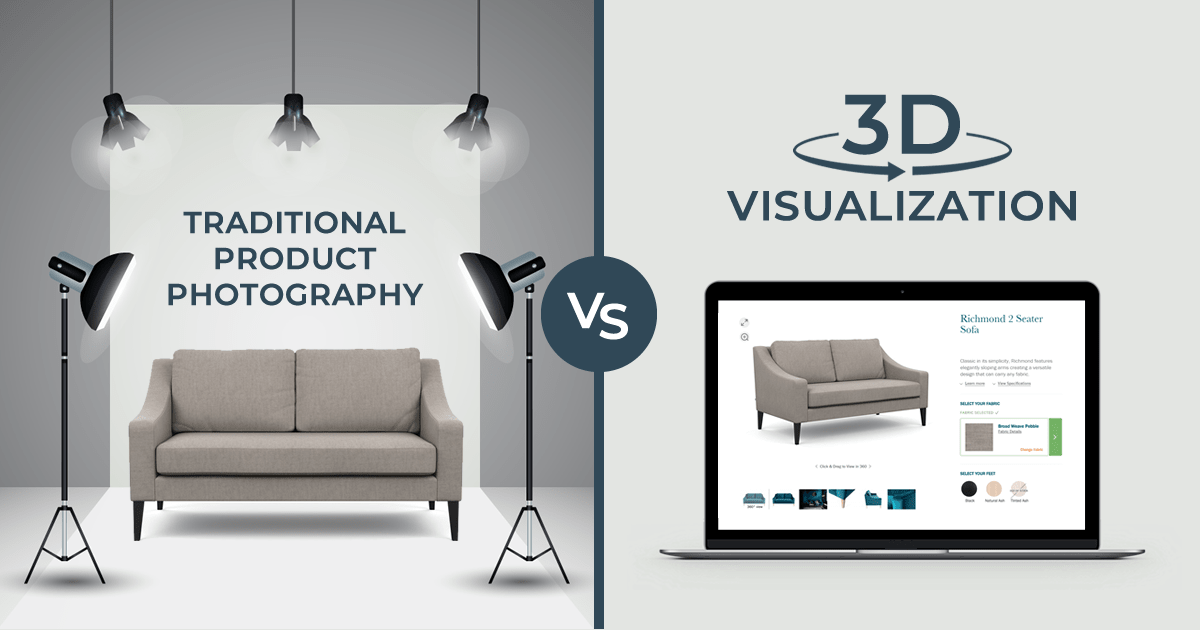
TL;DR: Furniture brands now have three ways to produce product imagery: photography, production-grade 3D and AI Master Assets. Photography gets more expensive with every variant and channel. Production-grade 3D covers hero and configurable products from one asset, and AI Master Assets cover the simpler longtail from four reference photos, with no content creation fee for eligible products.
Key points:
-
There are now three options, not two: photography, production-grade 3D and AI Master Assets each suit a different part of the catalog.
-
Photography has a scale ceiling: every fabric, finish and size needs its own shoot, so costs rise with the catalog.
-
3D savings compound: furniture brands using Cylindo report six-figure annual savings on content production.
-
One asset does more: the same 3D model powers 360-degree views, configuration, AR, lifestyle imagery and every sales channel.
-
AI Master Assets change the cost of the longtail: four reference photos become four 2K silo shots, with no content creation fee for eligible products.
3D product visualization costs more than a single photoshoot up front and far less over time. One 3D asset produces every variant, angle and channel format, while photography has to be repeated for each one. For furniture brands with configurable products, that's what decides the economics. And for simpler products that never justified either option, AI Master Assets now offer a third route.
3D visualization vs photography: why scalability matters more than quality
The realism debate is over. Modern 3D rendering looks like photography in real-world conditions, and has for a while: IKEA reported back in 2014 that around 75% of its catalog product images were already CGI.
The harder question in 2026 is operational. Picture a sofa in 47 fabrics, six leg finishes and three sizes, needed for your website, marketplace listings, in-store kiosks and trade catalog at the same time.
With photography, that's 47 shoots and counting. With 3D, you build the asset once and render the rest. Every new product, variant or channel widens the gap.
When photography still works, and when it breaks
For a brand with a small, stable catalog, simple colorways and no configuration, a well-run photoshoot still produces excellent results at a sensible cost. Fewer furniture brands fit that description each year.
Photography struggles in four situations:
-
Configurable products: every combination needs its own shoot. Interior Define couldn't realistically photograph every fabric across its customizable range. With Cylindo's visual commerce platform, every configuration appears on every product page.
-
Large or modular products: getting a sectional or an outdoor structure into a studio is slow and expensive. Yardistry, which sells large ready-to-assemble outdoor structures, used to send photography teams to its manufacturing site just to get product imagery. With 3D, that stopped, and its ecommerce sales doubled year on year.
-
Multi-channel distribution: a shoot produces images for one context. The website, retail partners, print, in-store tablets and social ads all want different formats, and photography can't keep up. 3D assets feed every channel from one source.
-
Fast product launches: photography ties launches to shoot schedules. With 3D, new configurations are rendered digitally, so products don't wait for samples. At MAKE Nordic, launch timelines dropped from weeks to days.
Where AI Master Assets fit: a lower-cost alternative for the longtail
Plenty of products can't justify a full production-grade 3D asset. Most catalogs carry a longtail of simpler items stuck with supplier snapshots, because neither a shoot nor full 3D made economic sense. That's why so much of a typical catalog has no decent imagery.
AI Master Assets are built for that gap. Someone takes four reference photos, on a phone if needed. Cylindo generates a 3D asset behind the scenes and delivers four studio-quality 2K silo shots, with up to 25 material variants. For eligible products on a 12-month subscription, there's no content creation fee.
They suit lower-configurability products with a single structural geometry, no patterned materials and no more than 25 material options. Output is probabilistic, so Cylindo runs several generations and you pick the best. Hero and highly configurable products still need production-grade 3D; our AI Master Assets vs 3D Master Assets comparison helps you decide product by product.

How much does 3D visualization cost compared with photography?
Building the first 3D asset costs more than one photoshoot. That comparison misses the point, though. What matters is the ongoing cost of content across the whole catalog, every variant and every channel, year after year. For eligible simpler products, AI Master Assets remove the content creation fee altogether.
Riverside Furniture, which sells through more than 3,500 retail partners, found that one room scene doesn't suit every market: as its team put it, a room scene for a product in the Midwest needs something different from one in the Southwest. Producing those variations through photoshoots meant shooting the same product again and again.
Proof of Impact: Riverside Furniture
Up to $100,000 Saved a Year. 3,500+ Retail Partners.
Riverside replaced photoshoot workflows with Cylindo Studio, and now produces lifestyle imagery for catalogs, social, print and its retail partners from its 3D assets.
Read the full case study here.
Life Outdoor Living came at it from a different angle. Its two-person ecommerce team couldn't photograph every modular combination, so many products had no imagery at all. With 3D, the whole catalog went online without growing the team, and the brand now saves €130,000 to €150,000 a year by replacing photoshoots and manual editing.
The sales side moved too. Online revenue rose 75%, lounge set sales grew 65%, and ecommerce nearly doubled its share of total revenue, from 3.7% to 6.8%.
"Buyers needed the confidence that our premium price matched premium quality. Cylindo's visuals remove that element of doubt."
Giel van Balen, E-commerce Manager, Life Outdoor Living
What 3D assets do that photography cannot
A photograph is a single image. A 3D asset keeps working:
-
360-degree views: customers spin the product and zoom into 4K detail to check stitching, joints and texture, much as they would in a store.
-
Real-time configuration: shoppers switch fabric, finish and size and see the result instantly. At MAKE Nordic, the share of customers customizing their furniture rose from 10% to 50%.
-
Augmented reality: the same asset runs as web-native AR, placing the product at true scale in the customer's room. You can't create this from photography.
-
AI lifestyle imagery: with Cylindo Studio and Quickshot, 3D assets go into generated room scenes without a studio. The 3D asset is what stops the AI inventing product details.
-
Every channel from one source: the website viewer, AR, dimension shots, lifestyle imagery, kiosks and marketplace listings all draw on the same verified model.
Does 3D visualization increase conversions and engagement?
Yes, and the effect shows up in revenue. According to Cylindo's Six Trends 2026 report, retailers using Cylindo's full product suite convert 35% or more than counterparts using static images. EQ3 saw a 36% increase in conversion and an 88% increase in AOV after adding Cylindo's 3D visualization.
Proof of Impact: Polly Products
3x Engagement. +17% Organic Traffic. Marketing Budget Up From $130K to $409K.
Polly Products swapped static photography for photorealistic 3D across its commercial outdoor range. Engagement tripled, and leadership expanded the marketing budget once it had the performance data to back it.
Read the full case study here.
Monte Design saw average time on page rise 50% after deploying Cylindo's 360 HD Viewer. On Wayfair, Ann Gish cut buyer's remorse returns by 35% and grew sales 20% year on year. Customers who can see a product accurately make better decisions and keep what they buy.
Business Impact
Real retailers. Published numbers.
See how Cylindo moves the three numbers your CFO already tracks: revenue, cost and returns.
See customer resultsWhen to keep photography, and when to move on
Photography still earns its place for lifestyle shots with real people, brand campaigns built on art direction, and editorial work where a real setting adds something.
"Chaos Cylindo has proven to be advantageous compared to traditional product photography. Its ability to quickly generate high-quality imagery is invaluable, especially when launching new products."
Felix Robitaille, Director of Marketing, Cozey
Where it falls down is as the main source of product page imagery at scale. Cylindo's own rule of thumb is simple: shoot the hero, render the rest. The brands doing best in visual commerce this year split the work: photography for human stories, production-grade 3D for hero products, configuration and AR, and AI Master Assets for the longtail. Our report on the six trends shaping furniture and visual commerce in 2026 looks at how leading brands are making that shift.
Brands that still rely on photoshoots for product imagery launch slower and cover fewer variants. Their content library can't power AR, AI or omnichannel distribution either, and the gap grows every quarter. One verified 3D asset can run the 360 viewer, AR, configurator, lifestyle imagery, dimension shots and AI product feed, and AI Master Assets bring the rest of the catalog onto the same platform. The real question is how quickly you can make the move without disrupting what already works.
Frequently Asked Questions
Is 3D visualization as realistic as traditional photography for furniture?
Yes. Modern photorealistic 3D accurately reproduces material texture, lighting, shadows and color, and IKEA reported back in 2014 that around 75% of its catalog product images were already CGI. For configurable furniture, 3D also covers far more variants than photography can.
What does switching from photography to 3D cost, and what does it save?
Building the first 3D asset costs more than a single photoshoot, but the ongoing cost of content across the catalog is much lower. Furniture brands using Cylindo, such as Riverside Furniture and Life Outdoor Living, report six-figure annual savings. For eligible simpler products, AI Master Assets have no content creation fee on a 12-month subscription.
Can 3D visualization handle lifestyle imagery?
Yes. Cylindo Studio and Quickshot place 3D assets into photorealistic room scenes without a physical studio. An accurate 3D asset matters here, because generic AI image generators working without one can invent product details. Photography is still the better choice for lifestyle content featuring real people.
How does 3D visualization support selling across multiple channels?
One Cylindo 3D asset feeds the website 360 viewer, AR, dimension shots, lifestyle imagery, in-store displays and marketplace listings from the same verified model. Photography needs separate assets for each context. FEST Amsterdam, for example, uses the same 3D assets on its website, in ads, on in-store tablets and in B2B presentations.
At what catalog size does 3D become more cost-effective than photography?
The crossover depends on configuration options more than SKU count. A brand with 50 products and 20 fabric options each faces up to 1,000 shots for full coverage, while 3D needs one asset per product. Most furniture brands with configurable products reach that point sooner than they expect.
Do AI Master Assets replace photography or production-grade 3D?
Neither entirely. AI Master Assets cover eligible simpler products, turning four reference photos into four 2K silo shots with up to 25 material variants. Production-grade 3D remains the right choice for hero and configurable products, and photography still suits campaigns featuring real people.